


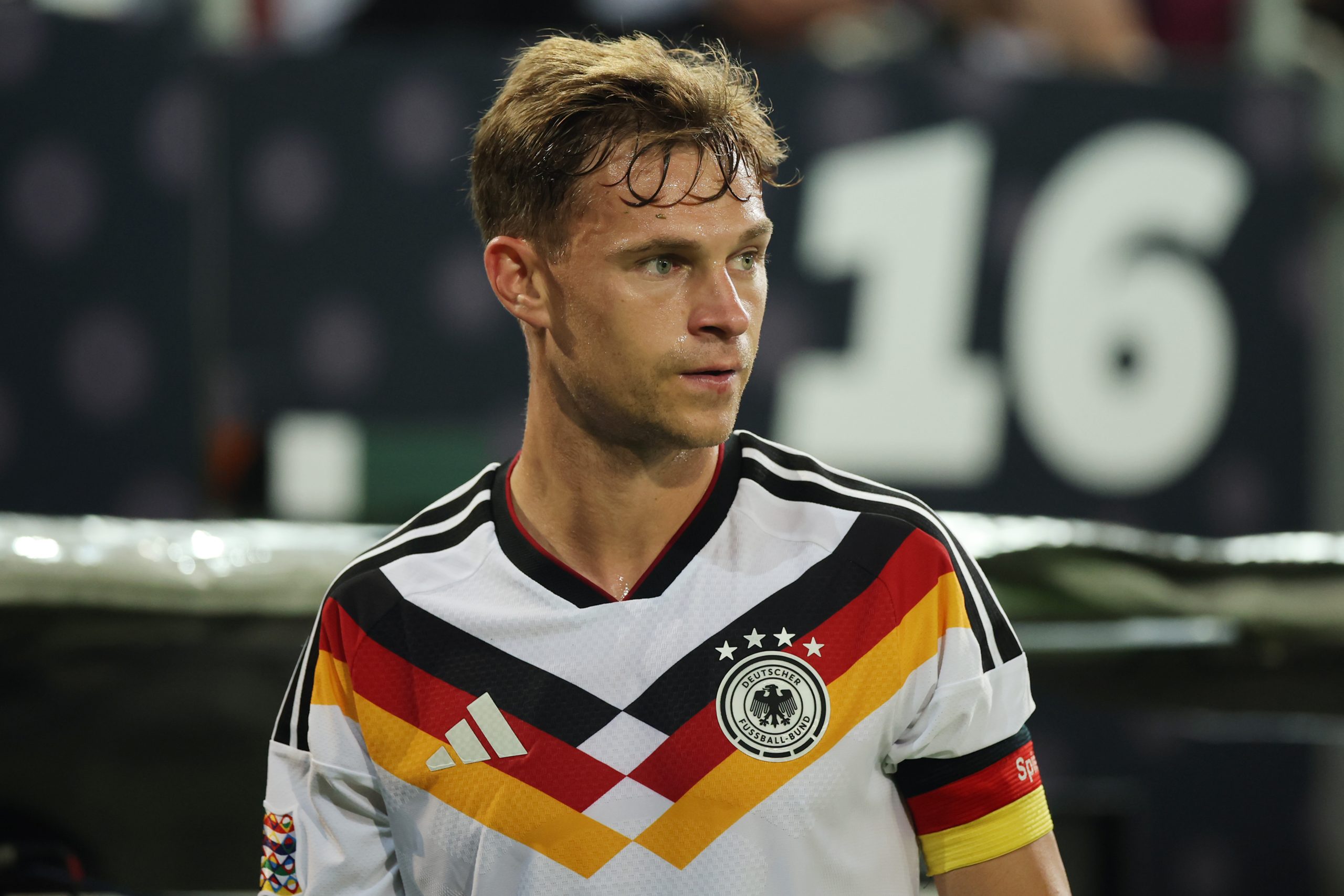
Following disappointing performances in Germany’s first two matches under new national team head coach Jürgen Klopp, Germany’s subsequent first victory under the new Bundestrainer has fueled the domestic debate over current national team captain Joshua Kimmich.
The Bayern Munich midfielder was not involved as Germany secured a comfortable 2-0 Nations League victory over Serbia on Thursday evening. Instead, Klopp deployed Kimmich’s Bayern teammates Aleksandar Pavlovic and Tom Bischof behind Florian Wirtz in a midfield trio that produced comfortably the most convincing football of his short tenure.
Klopp, for his part, wants little to do with suggestions that Germany may already have discovered a better formula without their captain.
Why is Joshua Kimmich not in Germany’s current squad?
Kimmich’s absence against Serbia was not a consequence of Germany’s disappointing start under Klopp. When the new Bundestrainer named an exceptionally large 44-man squad for his first Nations League window, the players were effectively divided into two separate groups. Kimmich was selected for the first block against the Netherlands and Greece but was not scheduled to remain for the matches against Serbia and Greece away.
The arrangement was deliberate.
Klopp wanted to use the unusually long international window to assess a much larger group of players than would normally be possible. Crucially, he also wanted to see how Germany’s younger and less established players functioned without the figures he described as the squad’s “top dogs” — the established senior players occupying prominent positions within the national-team hierarchy.
Kimmich therefore departed after captaining Germany in the opening two fixtures despite wanting to remain with the squad. That has naturally given rise to speculation that Klopp is using his opening international window not simply to examine alternatives, but to begin determining whether Germany’s midfield should continue to revolve around the 31-year-old.
The argument gained considerably more momentum on Thursday. Pavlovic controlled large portions of the Serbia match, Bischof played with considerable freedom alongside him and Wirtz delivered his finest performance of Klopp’s first three matches. The trio also appeared well suited to the aggressive pressing football the former Liverpool coach wishes to establish.
The contrast with Germany’s first two matches was difficult to ignore.
Kimmich remains, nevertheless, an enormously important figure. Klopp retained him as captain upon taking charge and immediately confirmed that he viewed the Bayern veteran primarily as a central midfielder rather than the right-back role he has repeatedly been asked to fill for Germany.
Thursday’s experiment — at least according to Klopp — should thus be understood less as a demotion than a deliberate test of what happens when Germany’s established midfield leader is removed from the equation.
Klopp pushes back against Kimmich debate
Klopp was visibly reluctant to allow the Serbia performance to become a referendum on his captain.
“Yeah, and then we get ourselves a Jo Kimmich story,” Klopp remarked at the post-match press conference when questioned about his captain’s absence. “That’s what you guys are up to. Look, he [Kimmich] gets [his job] done. Pavlovic, Bischof, and Wirtz did a magnificent job. Unfortunately, I can’t whistle along with your tune. We can play in a variety [of tactical constellations]. That’s the plan.
“We can play a certain type of football in a variety of different constellations,” Klopp continued. “The [level of] football must remain constant. The line-up can’t [remain constant] as [to take one example] players injure themselves. That’s always happening over the course of a season. In the event that someone is out, we’d be standing there looking like idiots saying that we can only play when this specific player is on the pitch.
“That doesn’t make sense,” Klopp concluded. “That’s one reason I’m very happy with the performance because I have the feeling that it doesn’t have to work only in this specific constellation. It worked in this particular constellation well on this particular day.”
Germany’s Kimmich debate will certainly not disappear
Klopp may not consider the matter worthy of controversy, but the debate itself is legitimate. The Germany coach deliberately removed several established players from his second squad precisely because he wanted to examine how younger alternatives responded without them. Pavlovic and Bischof then produced excellent performances in the first match played without Kimmich.
There is also a stylistic question that will continue to follow Germany. Klopp wants extraordinary intensity after possession is lost and praised his side’s counterpressing against Serbia as the defining feature of their performance. Determining which combination of Kimmich, Pavlovic, Bischof, Wirtz and Felix Nmecha best facilitates that football represents one of the most significant tactical decisions of Klopp’s early tenure.
The emergence of further options such as Vitaly Janelt, Bambasé Conté and Mika Baur only increases the competition.
Kimmich remains Germany’s captain and one of its most accomplished active internationals, but one tactical question remains especially pertinent. Much of his effectiveness for Bayern comes from supplying an elite attacking line from deep, frequently through long diagonals and chipped passes aimed at runners such as Michael Olise, Harry Kane, Luis Díaz and Ismael Saibari.
Germany cannot simply reproduce that attacking environment. Klopp must therefore determine whether Kimmich’s distribution can be integrated just as effectively into a national-team midfield built around different movements, pressing demands and attacking profiles.
Klopp’s attempts to reject controversy notwithstanding, whether Kimmich remains as indispensable to Germany’s midfield as he once appeared is now a legitimate question.