


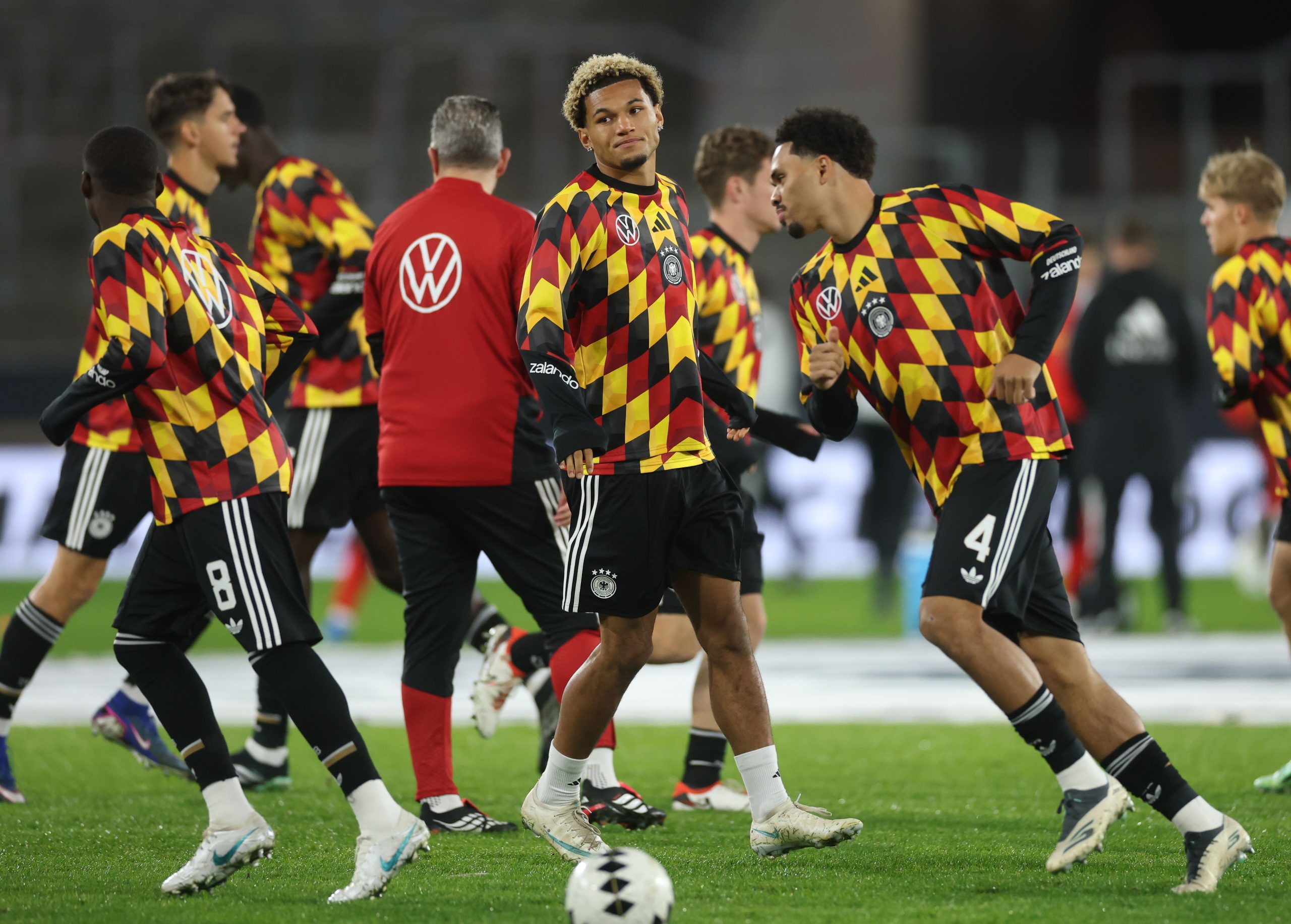
Germany U21 head coach Antonio Di Salvo has explained the tactical thinking behind the halftime changes that briefly turned Tuesday evening’s friendly against Croatia in Germany’s favor. Speaking to Get German Football News and other journalists at the post-match press conference, the 47-year-old specifically highlighted the introduction of TSG Hoffenheim striker Max Moerstedt and his decision to move Paris Brunner onto the left wing.
The DFB youngsters had entered the interval trailing 1-0 after a difficult opening 45 minutes in Rijeka. Thick fog, torrential rainfall, and a heavily waterlogged playing surface made conventional football increasingly difficult. Di Salvo nevertheless elected to make four substitutions at halftime, introducing Moerstedt, Nnamdi Collins, Leandro Morgalla, and Tom Rothe.
The decision paid immediate dividends. Germany emerged with renewed attacking impetus and overturned their deficit with two goals in seven minutes. Although Croatia eventually recovered to claim victory, Di Salvo acknowledged that the changes had accomplished what he intended.
Max Moerstedt makes excellent use of November break
Moerstedt’s introduction was particularly significant given the circumstances surrounding his late inclusion in the November squad. The Hoffenheim striker received his call-up after Club Brugge forward Nicolo Tresoldi withdrew through injury. Moerstedt subsequently made his Germany U21 debut during Friday’s 2-1 defeat to Belgium in Essen.
His second international appearance proved considerably more productive. In the 53rd minute, Cajetan Lenz redirected a Muhammed Damar free kick toward Moerstedt inside the Croatian penalty area. The 20-year-old remained alert after his initial effort was blocked and forced the ball home at the second attempt.
The equalizer rewarded Di Salvo’s decision to introduce a more conventional penalty-area presence. Moerstedt’s movement and persistence provided Germany with an additional attacking reference point as the visitors began exerting considerably more pressure on the Croatian defence.
The Hoffenheim youngster’s qualities have already been documented extensively in GGFN’s Bundesliga coverage. His ability to attack deliveries and remain dangerous in crowded penalty areas was also considered in our comprehensive 2026/27 Hoffenheim tactical preview.
Paris Brunner’s move to the left pays off
Di Salvo also confirmed that moving Brunner away from his more central starting position was an intentional part of the halftime adjustment. The AS Monaco attacker had operated alongside Dzenan Pejcinovic during the opening half, but his relocation to the left allowed Germany to make better use of his movement and attacking deliveries.
The change produced another decisive contribution in the 60th minute. Brunner supplied an excellent cross for Pejcinovic, who finished the delivery to give Germany a 2-1 lead. The former Germany U17 World Champion subsequently struck the post himself as the visitors threatened to extend their advantage.
The adjustment was consistent with GGFN’s previous tactical examination of Brunner’s versatility at U21 level. The Monaco professional has already demonstrated his ability to influence matches from the left, moving between wider positions and central attacking spaces according to the demands of the system.
Pejcinovic’s continued attacking productivity also deserves recognition. The Stuttgart striker, who played an important role in securing Germany’s qualification for next summer’s European U21 Championship, recovered from an unfortunate first-half miss to put his team ahead.
The extraordinary playing conditions ultimately prevented Germany from protecting that lead. Nevertheless, the response after halftime provided some encouragement for Di Salvo, particularly regarding the attacking options available to him.
The coach explained his thinking when addressing a question from Kicker’s Michael Pfeiffer at the post-match press conference.
“And when it comes to Max [Moerstedt],” Di Salvo carried on in addressing the second half of Pfeiffer’s question. “That was a substitution that proved worthwhile in that we wanted better presence in the box. Moving Paris [to the left] was something that we wanted as we wanted to have a player like that on the left [wing]. It paid off on our second goal.”