


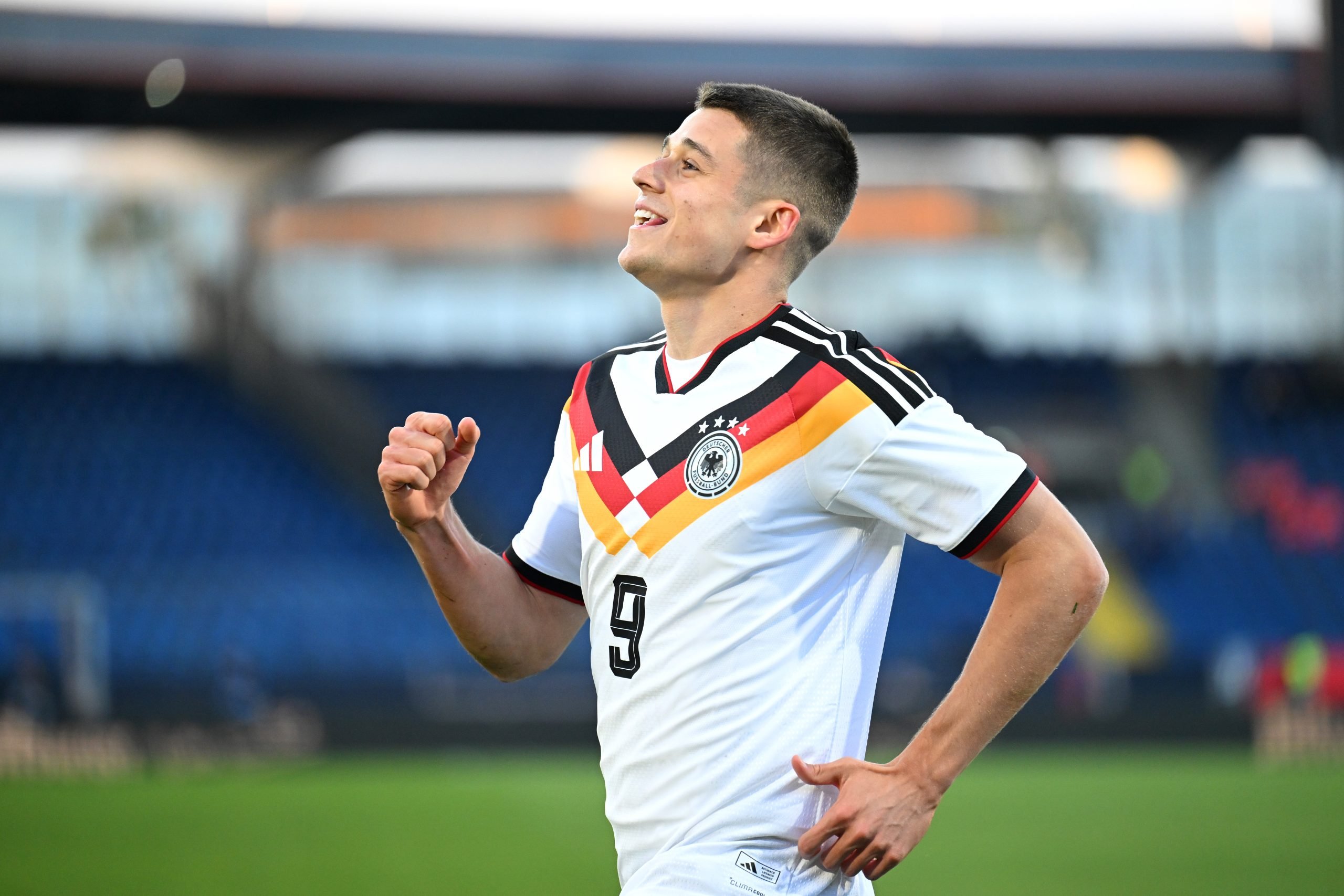
Two victories, eight goals and six points represent a fairly tidy return from the German U21s’ first two matches of the final international break of European Championship qualification. Naturally, the scorelines do not tell the entire story of Antonio Di Salvo’s Germany U21 squad.
Di Salvo’s side dispatched Latvia 4-0 before beating Malta 4-1 four days later, but both matches posed much the same tactical problem. Germany enjoyed enormous territorial superiority against opponents happy to defend deep, congest the center and wait for rare counterattacking opportunities.
The solutions have also looked increasingly familiar. Germany have sought width through aggressive fullbacks while allowing the nominal wide attackers to move closer to goal, with Nicolo Tresoldi remaining the fixed central reference.
The approach has produced plenty of attacking territory and, eventually, goals. It has not always produced clean positional play. That became especially clear during the Malta fixture, after which Di Salvo himself complained that his team lacked both passing quality and proper order.
Those familiar with GGFN’s running tactical documentation of this U21 generation will know that Di Salvo changing the shape is hardly new. The current qualification cycle began last September with some relatively straightforward 4-4-2s. October brought split-stagger variations and late 3-2-3-2 pushes, while November delivered still more positional experimentation. Our March review continued tracking the evolution.
The basic formation therefore remains only the beginning of the discussion.
Before the final qualifier against Georgia, there is plenty worth documenting.
Tactical Documentation: Latvia 0-4 Germany
Germany began in Riga with a relatively recognizable 4-2-3-1. Mio Backhaus started in goal behind Elias Baum, Linus Gechter, Joshua Quarshie and Lukas Ullrich. Noël Aséko and captain Tom Bischof occupied the central midfield positions, with Noah Darvich on the right, Paris Brunner on the left and Dzenan Pejcinovic operating behind Nicolo Tresoldi.
That last detail matters.
Pejcinovic was operating behind the striker from the opening minutes and repeatedly functioned as a distributor in central areas. Germany thus did not attack with three rigid players stationed behind Tresoldi. The role also fits what we have seen from Pejcinovic at this level before.
The striker already emerged as one of Germany’s most interesting performers during the opening international break of the qualification cycle, scoring against Albania and repeatedly threatening from flexible attacking positions.
Lineup—Germany U21 (Match One)
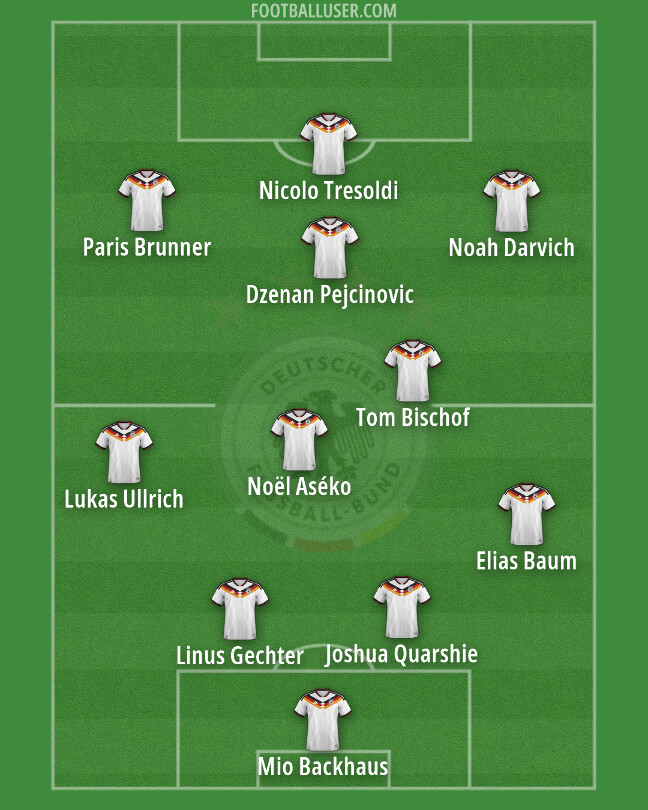
The double split-stagger involving Lukas Ullrich, Noël Aséko, Tom Bischof and Elias Baum produced some of Germany’s clearest attacking patterns. Brunner nominally began as the left winger, but Ullrich frequently advanced outside him. Germany generated plenty of their early pressure down that flank as the left-back repeatedly joined the attack.
The opening goal after only 52 seconds offered a neat example. Pejcinovic slipped Ullrich through on the outside. The fullback crossed low and Brunner arrived in the penalty area to force the ball over the line. Brunner’s second goal demonstrated the other side of the same role. Rather than remaining wide, he received near the left corner of the penalty area and bent a right-footed finish into the far corner.
This was no old-fashioned touchline winger merely waiting to cross. Brunner could begin on the flank, allow Ullrich to overlap and then enter the spaces in which he could actually threaten the goal. Latvia nevertheless made Germany work harder for the 2-0 halftime lead than the territorial dominance might suggest.
With virtually every Latvian player except the center-forward stationed deep, the hosts defended narrowly and crowded the central spaces. Germany led the corner count 8-0 at the interval but initially created relatively few clear opportunities after the opening goal. Brunner threatened again after 24 minutes. Bischof tried his luck from distance one minute later. Darvich later shot from the edge of the area.
For long stretches, however, Germany were circulating around rather than consistently penetrating the Latvian block. That represents an important distinction. Possession against a deep opponent is not the same thing as finding useful spaces inside that opponent. Germany did at least protect their dominance well. Latvia’s rare transition attempts were generally stopped early.
One sequence after 31 minutes was especially illustrative, with Aséko immediately recovering the ball after a Darvich turnover. The compactness behind the attack meant Germany could continue pinning Latvia back rather than repeatedly retreating to defend open counters. Brunner eventually supplied the individual quality for the second goal shortly before halftime.
After the break, the attacking tempo improved almost immediately. Pejcinovic released Tresoldi in the 48th minute. Bischof forced a save one minute later. Three minutes after that, the Bayern midfielder recognized Tresoldi’s run and played him through for a delicate finish over the goalkeeper. Substitute Arijon Ibrahimovic completed the scoring with a defected distance effort in the 76th-minute.
The structure had not required a halftime overhaul. Germany simply began using it more incisively. The first half had not necessarily revealed a broken formation. It had revealed a side that could control all the relevant territory without always exploiting that control quickly enough.
Bischof leaves and the hierarchy shifts
The Latvia match also contained one personnel development that would directly affect the next game. Bischof departed after 59 minutes because he was scheduled to join Jürgen Klopp’s senior national team. The move had been planned throughout the camp. Di Salvo had specifically wanted his captain available for the first qualifier before allowing him to move upward.
Bischof’s unusual movement between national-team levels is nothing particularly new. The Bayern midfielder already spent the previous cycle navigating the space between senior international and U21 football. After initially struggling to settle into the U21s, he ultimately established himself as one of Di Salvo’s captains.
When Bischof left the pitch in Riga, the armband passed to Tresoldi. That proved more than a temporary arrangement. Di Salvo subsequently named the Club Brugge striker captain for the remaining fixtures. Aljoscha Kemlein, meanwhile, was earmarked to take on greater sporting responsibility in midfield. That division was interesting.
Tactical Documentation: Malta 1-4 Germany
Di Salvo made eight changes ahead of the second fixture. Only Tresoldi, Brunner and Pejcinovic survived from the Riga starting XI as Max Weiß, Leandro Morgalla, Noahkai Banks, Soumaila Coulibaly, Tom Rothe, Aljoscha Kemlein, Francis Onyeka and Mert Kömür all entered the side. The best-supported reconstruction of Germany’s opening shape is a 4-3-3.
Kemlein operated as the central reference in a completely rebuilt midfield alongside Onyeka and Kömür. Crucially, Pejcinovic remained part of the attacking line rather than dropping into a double pivot. That meant Di Salvo had effectively changed the entire structure underneath his three retained forwards while preserving the Brunner-Tresoldi-Pejcinovic attacking trio.
Lineup—Germany U21 (Match Two)
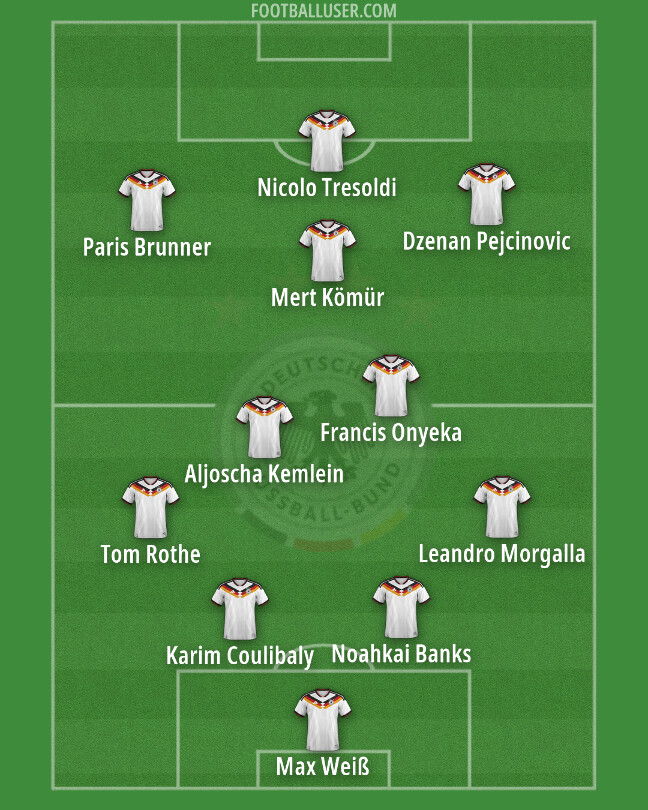
Only one split-stagger, and a significantly less pronounced one, this time. Germany’s plan initially revolved around keeping the fullbacks stationed deeper and ensuring that Onyeka and Kemlein didn’t operate too far apart. The opposition plan certainly required no decoding. Malta sat extremely deep. The hosts defended in two tightly packed lines and effectively parked the bus.
The hosts snatched an early lead when a Banks error led to a 9th-minute opener. Germany were invited to have the ball and asked to prove that they could break down the block without losing their own structure. This yielded more mixed results.
For much of the first half, they did neither particularly cleanly. Morgalla advanced all the way into the penalty area for Germany’s equalizer in the 11th minute. His curling shot hit the post before Tresoldi reacted first and converted the rebound.
Later, Brunner released Rothe on an overlap in the 30th minute. Rothe crossed toward Tresoldi before Malta eventually cleared. Two minutes after that, the left-back was not merely overlapping. He was standing inside the six-yard box. Kömür’s shot from a tight angle was saved and Rothe headed in the rebound for the 2-1.
As the half progressed, it became clear that Di Salvo was again asking his fullbacks to provide attacking width around forwards who were not required to remain attached to the touchline. Brunner could drift inward, combine or attack goal while the fullback travelled beyond him into the vacant outside lane.
The principle naturally extended to the opposite flank as well. Morgalla’s involvement in the equalizer showed how aggressively Germany’s right-back could join the final phase. Those advances supplied numbers around Malta’s defensive block. The other side of the equation was still always apparent.
A Tresoldi turnover in the 20th minute produced another Malta counter, forcing Onyeka to stop the attack with a tactical foul and accept a yellow card. Morgalla was then extremely fortunate in the second half when Tuma again attacked the right side of Germany’s defense and went down after the fullback extended a leg.
Germany were lucky that the referee booked the Maltese forward for simulation rather than awarding a penalty. Against Latvia, Germany generally recovered quickly enough after losses to keep the hosts permanently pinned back. Against Malta, the attacking commitment remained high but the protection underneath it became less reliable.
Di Salvo’s own post-match analysis went directly to the problem. The coach complained that Germany’s passing quality had been poor and, more importantly, that his team had difficulty maintaining their shape in possession. From an observer’s perspective, positional structure frequently failed the eye test. Di Salvo’s description thus fits the game better than the comfortable final scoreline.
Germany dominated possession and territory but repeatedly struggled to find their way through Malta’s compact shape. Attacks became too hectic and imprecise before halftime. By the 40th minute, Germany were repeatedly trying crosses from the half-spaces that the Maltese defense could simply clear.
The remaining two goals themselves also tell a story. Tresoldi headed home a Laurin Ulrich corner immediately after the restart. The captain completed his hat-trick with a direct free kick. Four goals constitute a perfectly respectable evening’s work. They do not necessarily constitute four examples of a low block being methodically dismantled.
Conclusions drawn from the first two matches
The same forwards, a different midfield
Perhaps the most interesting aspect of the Malta lineup was therefore not simply that Di Salvo rotated. It was where he preserved continuity. Germany changed eight starters but retained all three members of the attacking trio. Brunner, Tresoldi and Pejcinovic remained. Virtually everything underneath them changed.
That gives us a useful comparison with Latvia. In Riga, Pejcinovic frequently operated underneath Tresoldi and participated in the central distribution. Bischof supplied another high-level passing and connective presence from midfield. On Malta, Bischof was gone and Di Salvo reconstructed the midfield around Kemlein, Onyeka and Kömür.
The attack therefore had to establish connections with an almost entirely new supporting cast. At times, that looked exactly as awkward as one might expect. The passing lacked precision. Germany’s possession became untidy. Malta could remain narrow and wait for attacks to drift toward less dangerous crossing positions.
Tresoldi remains the reference point
Through all the rotation, one piece has remained fixed. Tresoldi started at center-forward in both matches and scored four goals. Before proceeding to the goals themselves, we should note that the unresolved question of Tresoldi’s eventual senior international allegiance remains in the background, just as it did a year ago. The speculation in the German football media shows no signs of abating.
Tresoldi’s Latvia goal came from recognizing Bischof’s pass and attacking depth. His first Malta goal was pure penalty-box anticipation after Morgalla struck the post. His second was a center-forward’s header from a corner. The third, a direct free kick, was rather less conventional.
Tresoldi now has 16 goals in 26 U21 appearances and, after inheriting Bischof’s armband, has also become the formal leader of the team. Two more strikes will see him draw level with Germany U21’s all-time leading goalscorer Pierre Littbarski.
His centrality is hardly a new development. GGFN’s March tactical review already had Tresoldi at the heart of Di Salvo’s successful qualification work, and the striker has since grown still further into the role.
The personnel around him can change. Brunner can begin left and attack inward. Ullrich or Rothe can advance outside him. Pejcinovic can work as a connector in advanced areas. Different midfielders can rotate through the structure.
Tresoldi remains there to occupy the central defenders and attack the box.
Brunner and the fullback relationship
The other continuity worth emphasizing involves Brunner. His first two U21 matches have already shown why his role cannot be understood merely by looking at where his name appears on the team sheet. He starts from the left. That does not mean he stays there.
Against Latvia, Ullrich repeatedly supplied the width while Brunner attacked the penalty area or moved into shooting positions inside. Against Malta, Rothe replaced Ullrich and the same basic relationship ultimately survived. Brunner could release the overlapping fullback and occupy more threatening positions closer to Tresoldi.
The two goals in Riga neatly illustrated his freedom to roam. For the first, he arrived close enough to goal to finish Ullrich’s cross from point-blank range. For the second, he moved inward from the left and curled a right-footed shot toward the far corner. Brunner therefore gives Di Salvo something especially useful against deep defenses.
Brunner can concentrate on becoming dangerous.
The Klopp effect reaches the U21s
It is impossible to separate this international window entirely from what is happening one level above. Bischof literally changed teams after the Latvia match. Finn Jeltsch, Said El Mala, Lennart Karl and other players who might otherwise have been available to Di Salvo have instead entered Klopp’s senior plans. Di Salvo has openly stated that the senior national team takes priority.
The traffic between the two levels itself has plenty of precedent.
GGFN chronicled Bischof’s own unusual senior-to-U21 path last November. During the same international break, Said El Mala returned from senior duty and immediately helped Di Salvo’s U21s defeat Georgia. All of this took place under a different coaching regime. If anything, Klopp – with his already well-documented habit of conducting in-depth personal conversations with players in and around his national-team pool – appears eager to accelerate movement across this bridge.
Klopp appears intent on keeping that pathway especially short. This U21 side therefore operates with an unusual degree of personnel fluidity. This is not simply a team preparing for its own tournament. It is also a development level from which the Bundestrainer appears willing to promote players quickly when he believes they are ready to make the leap.
What the final match against Georgia can tell us
Germany have completed the first two assignments of the international window and remain in control of their path toward the European Championship. The final qualifier against Georgia should offer another useful test. The question is not whether Germany can dominate possession against an opponent willing to concede territory. They have already demonstrated that.
The more interesting question concerns what they do with that dominance. Can the fullbacks continue attacking aggressively without leaving the rest-defense vulnerable? Can Brunner and the other forwards find cleaner routes into the spaces around Tresoldi instead of allowing possessions to drift toward hopeful crosses?
Can the midfield provide enough positional order to connect the first and final lines? And can Di Salvo preserve those relationships while the personnel continues to change beneath a senior national team increasingly willing to promote Germany’s best young players?
As GGFN has documented throughout this qualification cycle, Di Salvo rarely lacks tactical options.
The challenge lies in making all those options work together.