
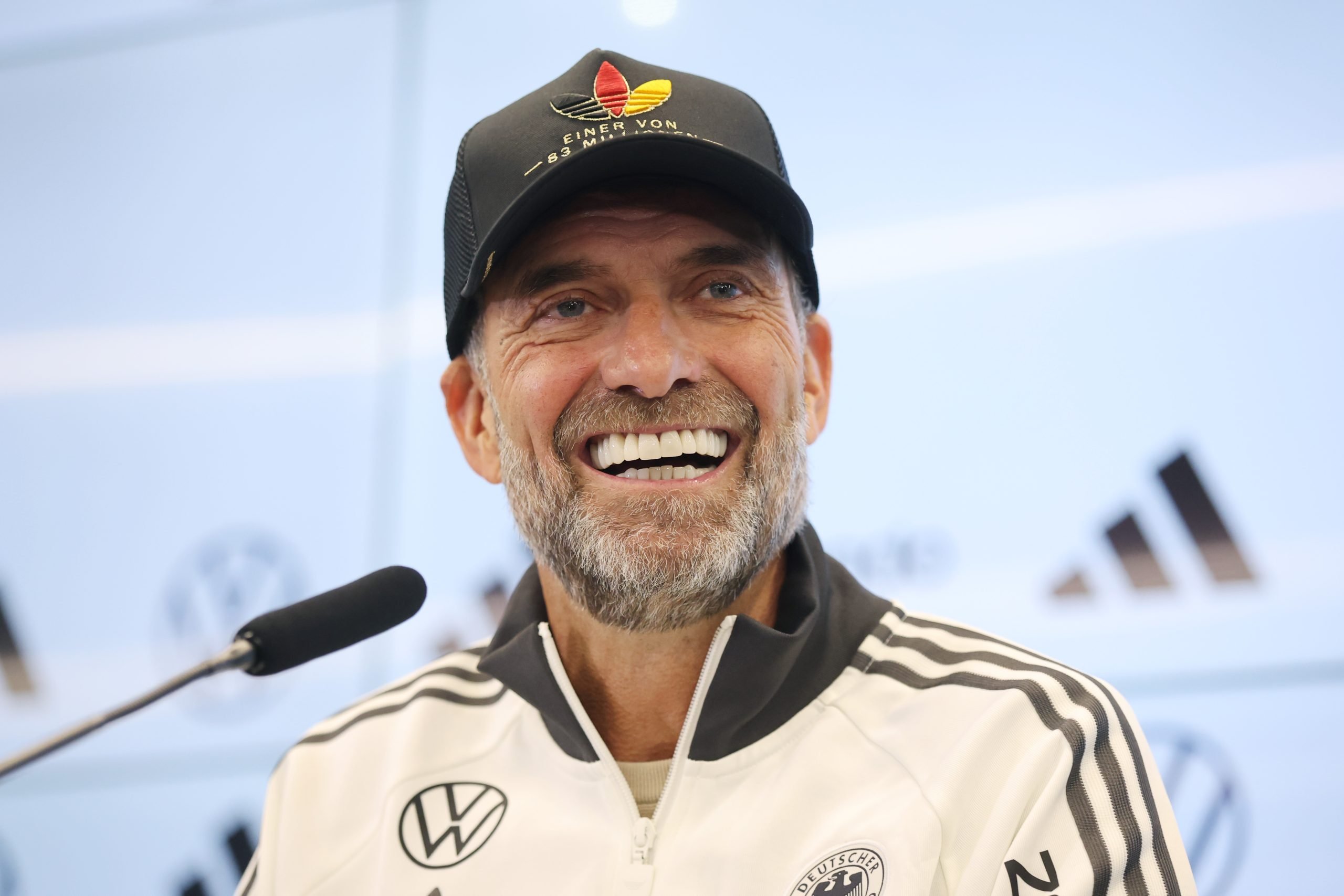
Jürgen Klopp has officially announced his first oversized squad since taking charge of the German national team. The new Bundestrainer named an extraordinary 44 players across two separate squads for Germany’s opening four UEFA Nations League fixtures. Eleven of them have never previously received a senior Germany call-up.
The newcomers hardly constitute one homogeneous group. There are highly-rated prospects whose progression through the DFB system always appeared to point toward this moment. There are former youth internationals who needed several loans before establishing themselves. One player was competing in the Regionalliga less than two years ago. Another has accumulated well over 100 Premier League appearances without ever playing in the Bundesliga.
SV Elversberg’s Felix Keidel arrives after only three German top-flight appearances and without ever having represented Germany at youth level. Brentford’s Vitaly Janelt, by contrast, won the European Championship with Germany U21 five years ago and has been waiting ever since.
Get German Football News now takes a closer look at all 11 newcomers.
Felix Keidel, SV Elversberg
Of all Klopp’s selections, none looks more improbable on paper than Felix Keidel. The Duisburg-born midfielder spent virtually his entire formative career at FC Ingolstadt, eventually making 82 appearances in the 3. Liga before Elversberg paid a reported €400,000 to bring him to Saarland in 2025.
Even there, the route toward the national team initially led backwards. Keidel made 25 appearances during Elversberg’s promotion campaign but collected all 13 of his league starts before the winter break. Jan Gyamerah moved ahead of him during the Rückrunde and Keidel was omitted from the matchday squad altogether twice during the decisive closing weeks.
There had been small flashes. A late substitute appearance at Karlsruhe in November 2025 produced Keidel’s first 2. Bundesliga goal, a stoppage-time winner in a 3-2 victory. Nothing at that stage nevertheless suggested that he would be preparing for senior international football less than a year later.
The decisive change came during the summer. Keidel had primarily been viewed as a full-back, but Vincent Wagner moved him into central midfield after Freddie Schmahl’s injury created an opening. Wagner later stressed that this was less a conversion than a return to the player’s roots. Keidel, in his coach’s words, was fundamentally a central midfielder who had ended up playing full-back in Ingolstadt.
By the end of preparation, Keidel had emerged as one of Elversberg’s clearest winners from camp. His running power, duel work and positional discipline suddenly offered Wagner a viable partner for Łukasz Poręba. Three Bundesliga matches have reinforced the impression.
Keidel covered an average of 12.18 kilometres across the opening three rounds and assumed responsibility for Elversberg’s set pieces. His direct free-kick equalizer during the remarkable 4-3 comeback against Borussia Mönchengladbach offered a particularly striking demonstration of another weapon.
He now joins Germany without a single previous DFB youth appearance.
Finn Jeltsch, VfB Stuttgart
Finn Jeltsch’s route could hardly be more different. The Stuttgart defender has long been regarded as one of the leading players of his generation. He won both the U17 European Championship and U17 World Cup with Germany in 2023 before establishing himself at boyhood club 1. FC Nürnberg.
Stuttgart were sufficiently convinced to make a significant investment after selling Anthony Rouault to Rennes in February 2025. Most of the money generated from that €15m departure was immediately recycled into two young centre-backs, with Jeltsch arriving from Nürnberg for €8m plus potential bonuses.
VfB sporting director Fabian Wohlgemuth called him one of Germany’s outstanding young players at his position. Jeltsch, meanwhile, acknowledged the emotional difficulty of leaving his “club of the heart” while recognizing that Bundesliga football constituted an opportunity he could not reject.
There were bumps. Former Nürnberg trainer Miroslav Klose later recalled that Jeltsch had been “thrown in at the deep end” and experienced something of a slump after his move. The response was convincing. Jeltsch received his first Germany U21 call-up ahead of the 2025 European Championship before beginning the next qualifying cycle as captain.
By September, the Stuttgart defender was already looking like the natural long-term leader of Antonio di Salvo’s new U21 generation. Unlike several names on this list, there is very little surprise in where the pathway ultimately led. Jeltsch has simply reached the senior team faster than might have been expected.
Hennes Behrens, FC Augsburg
A year ago, Hennes Behrens was still trying to turn reserve-team promise into meaningful senior football. The Hoffenheim youngster had accumulated only limited Bundesliga experience before leaving on loan for Heidenheim midway through last season. That move changed the trajectory.
Behrens made 16 Bundesliga appearances during Heidenheim’s ultimately unsuccessful fight against relegation, registering one goal and two assists. Even amid difficult results, the left-sided defender repeatedly demonstrated his appetite for attacking space from deep.
One February performance provided a useful snapshot. In a Heidenheim side fighting with its back against the wall, Behrens repeatedly cycled forward from left-back and helped provide the width necessary to push opponents backwards. Augsburg had seen enough.
The Bavarian Swabians paid approximately €3.5m for him this summer and immediately cleared his route toward the starting XI by allowing Dimitrios Giannoulis to return to PAOK. By early August, Behrens was openly targeting a permanent Bundesliga starting role and Manuel Baum appeared prepared to give him one.
Then came an excellent preseason. The versatility Hoffenheim II had once used across several positions suddenly looked like an additional strength rather than a sign of positional uncertainty. Behrens scored against Sassuolo, attacked aggressively from the left and looked ideally suited to Baum’s wing-back role.
The assessment in Augsburg’s preseason tactical preview opened simply: “Get to know the name.” The expectation at the time was that Behrens would soon make his mark for Germany at U21 level. Instead, after logging maximum minutes in three Bundesliga starts, Klopp has accelerated that timetable.
Behrens did a particularly good job drawing attention to himself in this past weekend’s 2-2 draw against Bayer Leverkusen with a fine set-up of Michael Gregoritsch’s club record tying goal shortly after the restart. Behrens started the attack and supplied Gregoritsch with a perfectly weighted through ball.
Max Rosenfelder, SC Freiburg
Max Rosenfelder may have taken the most difficult route of all the Freiburg newcomers. The Freiburg native has supported SCF since childhood and rose through the club’s own academy. The footballing ability was rarely the problem. Remaining fit was. Rosenfelder lost enormous chunks of his early senior career to physical problems.
When fit, he repeatedly looked capable of forcing his way into Freiburg’s Bundesliga defense. When unavailable, the development process effectively reset. The 2024/25 season initially appeared to represent the breakthrough. Rosenfelder earned a regular starting role under Julian Schuster, broke into Germany’s U21 side and began attracting outside interest.
By November 2024, he had started nine of Freiburg’s opening 11 league matches and his estimated market value had risen from €500,000 to €4m in the Transfermarkt listings. Freiburg rewarded him with another contract extension. Club boss Jochen Saier’s comments at the time neatly summarized the situation: when Rosenfelder stayed healthy, the club had no doubts whatsoever about the sporting quality.
Unfortunately, the condition attached to that praise remained important. Further injury setbacks disrupted the following year badly enough that Freiburg’s winter squad assessment had become strikingly pessimistic. What once looked like an obvious academy success story had become a genuine question of whether Rosenfelder could ever recover his Bundesliga trajectory.
He did. Rosenfelder entered the summer of 2026 having finally completed a prolonged stretch without another setback. For once, he made it through the entire preseason without missing a training session. The old attributes immediately re-emerged: aggressive front-foot defending, assured buildup work and exceptional recovery speed. Rosenfelder has previously been clocked at 35.91 km/h, an extraordinary figure for a central defender.
By Freiburg’s final preparation match against Crystal Palace, he had moved strongly into contention alongside—and at times ahead of—more established options. The conclusion in Freiburg’s season preview proved unusually timely: Rosenfelder’s resurgence was no joke and Germany might soon come calling. Klopp needed less than a month to make that prediction reality.
Philipp Treu, SC Freiburg
Rosenfelder’s Freiburg teammate Philipp Treu had to leave Freiburg before he could return as a Bundesliga-level Freiburg player. The academy product departed for St. Pauli in 2023 for approximately €500,000 without ever having played Bundesliga football for SCF’s first team. Two years in Hamburg transformed the Heidelberg native.
Treu helped St. Pauli earn promotion before becoming almost impossible for Alexander Blessin to remove from his Bundesliga XI. He started 33 of 34 league fixtures during the 2024/25 survival campaign, providing the running power, aggression and tactical reliability required from either wing-back position. Freiburg subsequently acknowledged just how far their former academy player had progressed.
Having sold Treu for roughly €500,000, the club paid a St. Pauli-record €5m to bring him home. Klemens Hartenbach emphasized exactly what had changed: Treu had developed into a consistent defender capable of creating chances while combining elite stamina with sprinting ability. The return initially hit an obstacle when a shoulder injury interrupted his first Freiburg preseason.
By the winter break, however, Treu had overcome the setback and established himself as a genuine first-team solution. His versatility grew as well. Treu could operate on either flank, and late last season Freiburg even used him on the left when greater defensive stability was required. Klopp contacted the defender directly before this international window. Treu confirmed that the pair held a FaceTime conversation in which the new Bundestrainer explained his ideas.
The invitation has now followed.
Derry Scherhant, SC Freiburg
Derry Scherhant’s first taste of Bundesliga football came amid chaos. The Berlin-born attacker broke into Hertha’s senior side during the club’s 2022/23 relegation crisis. Pal Dárdai turned to him as one of several internal solutions for an attack desperately short of answers. Scherhant scored his first Bundesliga goal against Borussia Mönchengladbach, but regular football proved difficult to secure inside a club lurching toward relegation.
The drop ultimately provided him with something he needed: time. Scherhant matured in the 2. Bundesliga and finally moved closer to the national-team pathway in March 2025, when a late call from Antonio di Salvo brought him into the Germany U21 squad. Freiburg moved soon afterwards.
The Breisgau club activated a reported €2m clause in his Hertha contract. Scherhant spoke at the time about the immediate “energy and drive” he sensed from Freiburg and emphasized that his priority was accumulating as many minutes as possible. The transfer offered him a far more stable environment in which to pursue them.
Those minutes did not immediately come as starts. Vincenzo Grifo remained almost impossible to dislodge on the left, leaving Scherhant initially cast as an impact substitute. His contributions were nevertheless meaningful. A dramatic comeback victory against Stuttgart brought his second Bundesliga goal after a wait of almost two years.
By the winter break, Scherhant had scored five times across all competitions. The next problem therefore became positional rather than performance-based. Freiburg began exploring ways of getting him onto the pitch away from Grifo’s left side. Scherhant worked on the right, centrally behind the striker and in more flexible attacking arrangements.
By this summer, that work had significantly broadened his value. Interest from Ipswich arrived just as Scherhant had begun creating multiple routes into Freiburg’s XI. Freiburg had little reason to sell. Scherhant followed with one of the strongest preparations in the squad and entered the new season no longer merely waiting behind Grifo.
In point of fact, it’s now the legendary Grifo who is having difficulty securing minutes. Scherhant has started five of Freiburg’s six competitive fixtures thus far this cycle. Scherhant took the left in all three Bundesliga fixtures and both Conference League qualification matches. Grifo only found his way into the XI during the Pokal. Even then, Scherhant relieved him late.
Yannik Engelhardt, SC Freiburg
Yannik Engelhardt climbed virtually every rung available before receiving his first senior Germany invitation. He played fourth-tier football with Werder Bremen II, moved into the 3. Liga with Freiburg’s reserves and established himself in the 2. Bundesliga with Fortuna Düsseldorf. Düsseldorf’s 2023/24 campaign transformed his career sufficiently for Como to pay approximately €8m and take him to Serie A.
Still, one childhood objective remained unfulfilled. Engelhardt had never played in the Bundesliga. Borussia Mönchengladbach finally offered that opportunity in September 2025. The midfielder arrived on loan without an obvious starting place in an already crowded central unit, but described Bundesliga football as a dream he had carried since childhood.
He did not take long to become indispensable. Engelhardt’s intelligence, work rate and capacity to provide structure pushed him ahead of more established options. What looked like an opportunistic deadline-day loan turned into 31 Bundesliga appearances, two goals and three assists.
Freiburg had been watching. The club knew Engelhardt particularly well from his two seasons with the reserves between 2021 and 2023 and never completely lost contact with him. This summer, Freiburg paid €7m to bring their former reserve midfielder back from Como. His first Freiburg preseason suggested that the fit remained natural.
Engelhardt steadily played his way into the vacancy alongside Maximilian Eggestein and scored in the Generalprobe against Crystal Palace by continuing his run into the penalty area. By the time Freiburg’s tactical picture was assessed before the season, Engelhardt had essentially made the midfield position his. Last weekend, he picked up Man of the Match honors after scoring a brace against his former Bundesliga club.
Fourth tier. Third tier. Second tier. Serie A. Bundesliga. Germany. Few players in Klopp’s new group have climbed the ladder quite so methodically.
Bambasé Conté, Hoffenheim
Bambasé Conté’s inclusion provides another example of development taking place away from the parent club. Hoffenheim had already seen enough to believe in the attacker several years ago. Conté made seven substitute appearances for the senior team during 2023/24, but there was no obvious route toward the regular football required for the next step.
The solution was Karlsruhe. Hoffenheim sent Conté to the 2. Bundesliga in summer 2024, with club officials emphasizing that the move was intended to convert the “exceptional abilities” they witnessed in training into meaningful senior minutes. The developmental process continued thereafter at Elversberg.
By the time Vincent Wagner’s side won promotion, Conté had become important enough that his return to Hoffenheim created one of the very few genuine holes in an otherwise remarkably intact starting XI. That was evident when Elversberg’s Bundesliga squad was examined this summer. Among the departures from the promotion side, Conté was effectively the only starting player whose absence required a substantial tactical replacement.
Interestingly enough, Conté has only started two of Hoffenheim’s four competitive fixtures. The now 23-year-old has made his mark with three assists across all competitions, yet doesn’t quite count as a regular amid Hoffenheim’s deep squad. The Saarbrücken native has also never featured for Germany at U21 level and graduates directly from the U20s.
Younes Ebnoutalib, Eintracht Frankfurt
No player in the group has travelled from obscurity to the national team faster than Younes Ebnoutalib. The Frankfurt-born striker passed through the youth systems at Wehen Wiesbaden and Rot-Weiß Frankfurt without emerging as an obvious Bundesliga prospect. As recently as the first half of 2025, he was playing Regionalliga football for FC Gießen.
Elversberg paid roughly €50,000 for him in January of that year. Even then, nothing happened immediately. Ebnoutalib spent most of his first months with Elversberg’s reserves and made only four extremely brief 2. Bundesliga appearances. Horst Steffen included him in both promotion-relegation playoff legs against Heidenheim, but Ebnoutalib entered each match only in the 90th minute.
Then came one of the most remarkable scoring explosions in recent German second-tier football. Three consecutive braces between Matchdays 4 and 6 of the following season thrust Ebnoutalib into the spotlight. A hat-trick followed. Within four months, his estimated market value jumped from €150,000 to €6m.
Frankfurt eventually beat Wolfsburg to a striker Elversberg had purchased for the price of a modest fourth-tier gamble. The total package reportedly reached approximately €10m. There remained a legitimate question over whether the rise had happened too quickly. Ebnoutalib had essentially gone from Regionalliga player to Bundesliga striker in twelve months.
His first top-flight appearance supplied an immediate answer. Starting against Borussia Dortmund in January, Ebnoutalib scored on his Bundesliga debut. One year removed from FC Gießen, he admitted to feeling almost overwhelmed while running through on goal before finding the finish.
An ensuing knee injury interrupted the momentum and prevented the second half of last season from becoming the sustained breakthrough it initially promised. Ebnoutalib responded this August with an opening-day Bundesliga hat-trick against Union Berlin. While the current state of SGE tactics may lessen his involvement under Adi Hütter, the one-time €50,000 Regionalliga purchase can now boast being a Germany call-up.
Vitaly Janelt, Brentford
If Ebnoutalib’s call-up feels extraordinarily early, Vitaly Janelt’s feels extraordinarily late. The Hamburg-born midfielder came through RB Leipzig’s youth system, moved to Bochum and left Germany for Brentford in 2020 for approximately €600,000. He never came back.
Instead, Janelt helped Brentford reach the Premier League and established himself there for years, operating as a defensive midfielder, central midfielder, centre-back and full-back when required. By October 2025, the curious shape of his career had become impossible to miss: Janelt had made 139 Premier League appearances without ever playing a single Bundesliga match.
His national-team story was similarly unusual. Janelt made ten Germany U21 appearances and was part of Stefan Kuntz’s European Championship-winning side in 2021. Senior recognition never followed, despite reports that Hansi Flick had once considered him.
Eventually, another option emerged. Janelt acquired Bosnian citizenship amid indications that Bosnia & Herzegovina might offer the senior international career Germany never had. Klopp’s arrival has changed the equation.
This is not a speculative call for an emerging talent. Janelt is an established Premier League professional being given the Germany opportunity that eluded him throughout most of his twenties. The contrast with Keidel illustrates just how broad Klopp’s first casting call really is.
One midfielder arrives after three Bundesliga appearances. The other needed more than a hundred Premier League matches.
Mika Baur, Celtic
Mika Baur’s rise has been compressed into barely a year. The former Freiburg academy attacker moved to Paderborn in summer 2024 for approximately €500,000 but initially required another developmental detour, spending part of his first season on loan with Dynamo Dresden in the 3. Liga.
The return to Paderborn changed everything. By November 2025, Baur had established himself as an important attacking midfielder for a team leading the 2. Bundesliga. When Assan Ouédraogo was promoted from Germany U21 to the senior national side, Baur received the late call to replace him.
At that stage, merely establishing himself at Germany’s highest youth level constituted the next milestone. Ten months later, Klopp has promoted him too. In between came promotion with Paderborn and a transfer saga that demonstrated how much his value had changed.
Celtic pursued Baur aggressively during the summer. Paderborn refused to compromise significantly on their €5m valuation despite the player’s contract situation, even appearing prepared to risk losing him for nothing rather than accept a heavily discounted offer.
The Scottish champions eventually completed the deal in August. The reported structure—€5.25m up front with up to €2.75m in bonuses—made the potential €8m package a Paderborn record sale.
Two years earlier, Baur had cost approximately €500,000. One year earlier, he still required 3. Liga minutes. Ten months earlier, he had never played for Germany U21. Now he is part of Jürgen Klopp’s first senior national-team selection.
Eleven different routes to the same place
Klopp’s first squad does not simply expand Germany’s player pool numerically. It reaches into almost every corner of the country’s development system.
Jeltsch represents the classic elite-prospect route. Rosenfelder represents what can happen when a gifted academy player finally escapes the injury cycle. Treu had to leave home before earning his way back. Engelhardt climbed steadily through four divisions and two countries. Conté and Behrens benefited from the loan market. Scherhant required relegation, second-tier football and positional reinvention.
Ebnoutalib’s ascent has bordered on absurd. Baur’s has simply been extremely fast. Janelt has already built the kind of senior career many of the others are still chasing. And then there is Keidel, a player who entered the summer trying merely to win back a club starting place and enters the autumn as a German international.
For these eleven, merely reaching the starting line already tells eleven very different stories.