


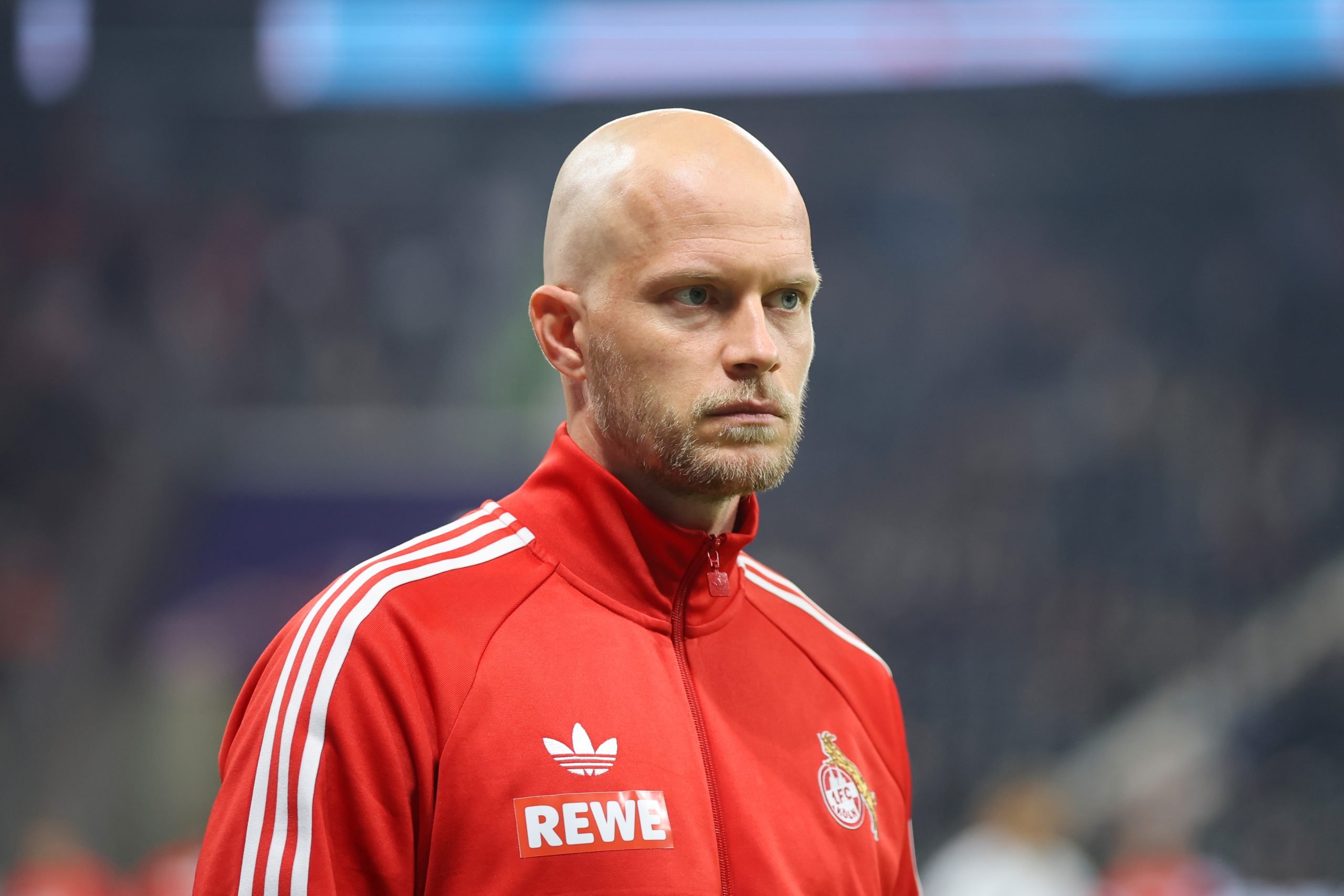
Cologne head coach René Wagner has explained the reasoning behind his team’s surprise tactical switch ahead of Friday evening’s 1-0 Bundesliga defeat away at Eintracht Frankfurt. The tactical experiment produced some encouraging results, but familiar problems resurfaced as Cologne surrendered control of the match after halftime.
The defeat brought Cologne’s momentum following last weekend’s 2-1 Rhein-Derby victory over Borussia Mönchengladbach to a sudden halt. Frankfurt, meanwhile, secured their first Bundesliga home victory since March thanks to Younes Ebnoutalib’s 77th-minute winner. Wagner’s back-five largely worked, but clearly sat to deep during a crucial phase after halftime.
Wagner reveals plans behind Cologne’s tactical adjustment
“The idea with the back-five was in the works for a long time,” Wagner remarked at his post-match press conference. “It was something that fit for the Frankfurt game. We knew that we wanted to play with it today. It wasn’t something that was a reaction from the Gladbach game or any other sort of development. We simply wanted to build the back five into our portfolio while we think that it’s a good thing for us to be able to play more tactically flexible.”
The adjustment was hardly without precedent. As examined in Get German Football News’ comprehensive 2026/27 1. FC Köln tactical preview, Wagner had already experimented with a three-man defensive line during the summer. The formation proved particularly effective during the second half of a preseason friendly against Real Sociedad.
Friday’s variation featured Joël Schmied, Jahmai Simpson-Pusey, and Luka Lochoshvili in central defense. Cologne defended in a compact 5-3-2, with Linton Maina dropping deeper while wingbacks Borna Sosa and Sebastian Sebulonsen provided width. Wagner’s team remain without their two principal centre-forward options, Ragnar Ache and Thijs Dallinga, due to injury.
The arrangement initially worked well. Frankfurt struggled to find space between the lines, while Marius Bülter and Said El Mala threatened on the counterattack. Bülter twice forced SGE keeper Noah Atubolu into important interventions, and El Mala narrowly missed the target following a spectacular 50-meter solo run shortly before halftime.
“Having an extra defender to defend the box in away matches helps us to defend the box better,” Wagner explained. “For that reason, it was a step in our development to have a look if we can defend a little deeper in away matches and counter appropriately. We knew that Frankfurt had some problems in that regard.”
A familiar problem returns after halftime
Unfortunately for Wagner, the encouraging opening period gave way to an increasingly passive second-half performance. Frankfurt took control after the restart, repeatedly recovering possession high up the pitch and forcing Cologne into extended periods of defending. The visitors struggled to create meaningful counterattacking opportunities, while the hosts generated several dangerous chances before Ebnoutalib finally broke the deadlock.
“Unfortunately, in the first 20 to 25 minutes after the restart, we weren’t able to cause problems for Frankfurt,” Wagner acknowledged. “During that phase we were simply stuck too deep.”
The explanation bears a striking resemblance to the difficulties Köln encountered during September’s 1-1 home draw against Werder Bremen. As Get German Football News reported at the time, both Linton Maina and Tom Krauß publicly criticized their team’s inability to respond when Bremen began taking control.
Wagner himself acknowledged after that match that Köln had spent approximately 20 minutes trapped inside their own half, struggling to find a way out. Friday’s defeat offered another example of the same worrying pattern.
El Mala and Schwäbe voice frustration
The frustration was evident in the reactions of Cologne’s players. Speaking to Sky Germany after the match, El Mala claimed Frankfurt had looked almost completely beaten during the first half.
“Frankfurt suddenly became a little more aggressive and had even more motivation,” the German international observed when discussing the change after halftime. “Why? I don’t know! They were totally dead!”
Goalkeeper Marvin Schwäbe was particularly critical of the defending that preceded Ebnoutalib’s winner, suggesting that his teammates had effectively escorted Frankfurt’s attackers toward goal rather than engaging them in challenges. Schwäbe also acknowledged that Frankfurt improved while Cologne became increasingly passive.
The result extended Cologne’s Bundesliga away winless streak to 16 matches. The cathedral city club have also now conceded at least once in 20 consecutive league fixtures. The back-five experiment nevertheless need not be considered a failure. Wagner’s team demonstrated that the formation can provide a useful alternative to their established four-man defense, particularly when facing dangerous opponents away from home.
The greater concern is that changing the system has not yet solved Cologne’s recurring inability to maintain their intensity and defensive organization across an entire match.
That remains the challenge confronting Wagner as his team prepares to host Schalke 04 next Saturday.