


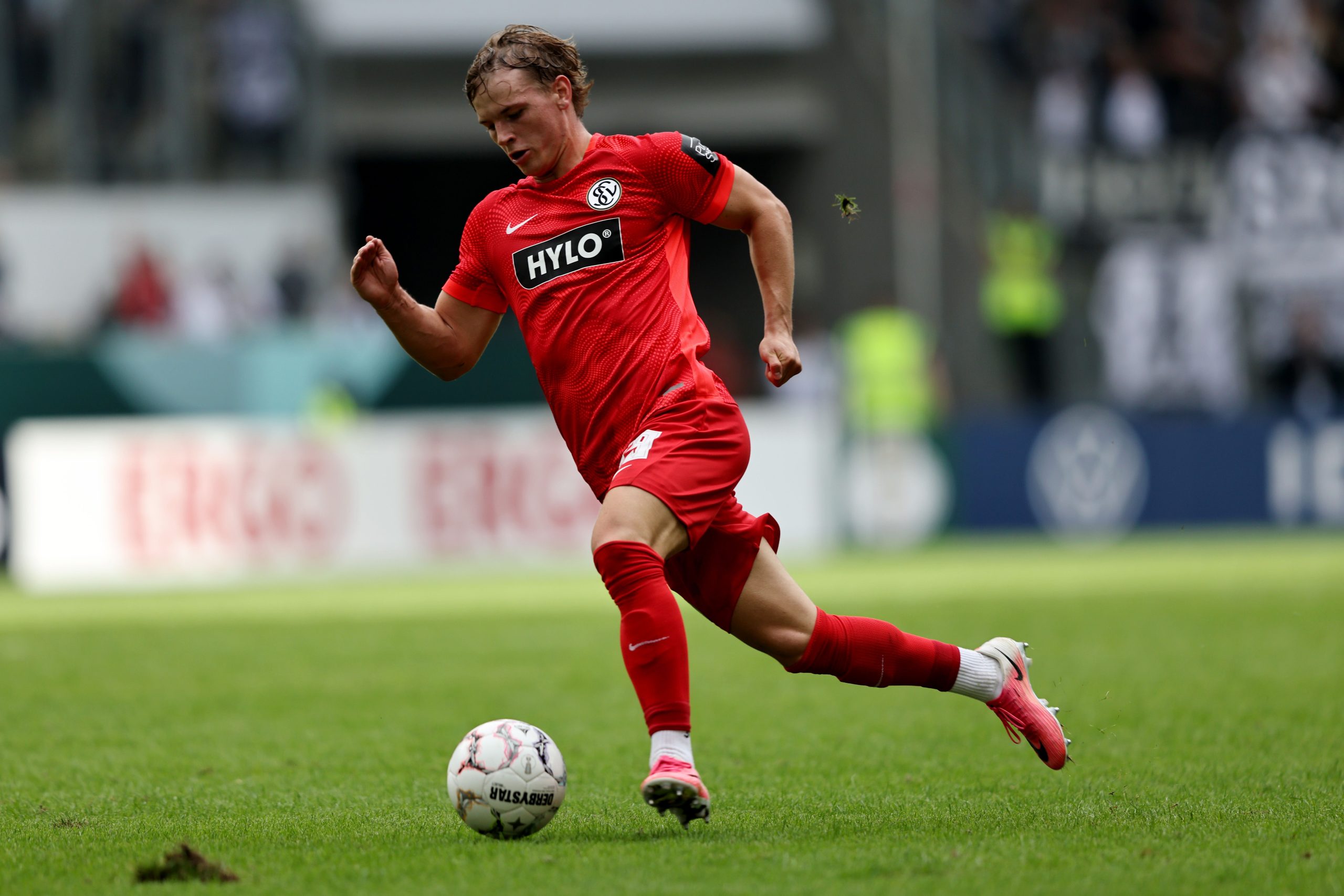
Cole Campbell’s first weeks as a Bundesliga starter have offered an appropriate snapshot of the wider SV Elversberg story. Three matches into the newly-promoted club’s maiden German top-flight campaign, Elversberg have already defeated Bayer Leverkusen, overturned a two-goal deficit away at Borussia Mönchengladbach and pushed Bayern Munich hard in a narrow defeat.
Campbell has been right in the middle of it. The youngster took time to discuss his team, his own individual performances, and a variety of interesting topics at a Bundesliga media roundtable attended by Get German Football News. Campbell’s rise is among the more interesting stories to emerge from the young 2026/27 Bundesliga campaign.
The 20-year-old American scored in the historic 3-2 opening-day victory over Leverkusen and has started all three league fixtures on the left wing. Twelve months after his path toward regular Bundesliga football at Borussia Dortmund appeared increasingly uncertain, Campbell now occupies an important role at a club whose entire sporting model revolves around giving talented young footballers precisely such an opportunity.
For Campbell, that history mattered when Elversberg came calling.
“Of course, they told me about it and I looked into it myself,” Campbell said when asked about Elversberg’s impressive record of developing talent. “Whenever you want to join a club, it’s important that you learn about what they’ve done in the past. That obviously influences what you think about going there. I had a lot of conversations with the coach and the sporting director about the club.”
Those discussions ultimately convinced Campbell that Saarland represented the right place to restart a career that had lost momentum.
“They explained to me their plan and what the club is about,” Campbell continued. “When you have other players who have gone there and developed, gotten their minutes, and made a big step for themselves, obviously it helps. It had an influence on me coming here. I needed a club that believes in me and gives me the support and backing to become the best version of myself.”
Campbell finds his Bundesliga pathway at Elversberg
Campbell’s route to this point has hardly been straightforward. The Houston-born winger joined Dortmund as a 16-year-old after spending part of his formative footballing years in his mother’s native Iceland. His pace and one-on-one ability quickly marked him out as one of the more intriguing attacking prospects in the BVB system.
A senior debut followed during the 2024/25 campaign. The following summer nevertheless brought considerably more uncertainty. Campbell wanted regular Bundesliga football and came close to leaving Dortmund for Stuttgart. The transfer ultimately failed to materialize.
GGFN’s 2025/26 Borussia Dortmund tactical preview remained skeptical about whether Campbell was ready to command a significant first-team role after a quiet preseason. That concern proved prescient. Campbell barely featured during the opening months of the campaign and was eventually left out of Dortmund’s matchday squad amid reported concerns over his training performances in December.
The American was reinstated shortly thereafter, but a clearer pathway still failed to emerge. Dortmund eventually loaned Campbell to Hoffenheim in January with a purchase option. The temporary move did not lead to a permanent stay.
Elversberg instead invested a reported €6m in Campbell this summer, making him the largest individual expenditure in an ambitious recruitment drive centered almost exclusively around young talent. Campbell did not simply arrive with a large transfer fee attached to his name.
He earned his place.
GGFN identified Campbell as one of the players to emerge most positively from Elversberg’s preseason work. He hit the post, helped create Luca Schnellbacher’s goal and scored himself during an impressive 4-1 friendly victory over Lorient. By the end of camp, Campbell had moved ahead of the competition for the left-wing position.
The attraction was obvious. Vincent Wagner wanted a direct attacker capable of accelerating at defenders and attacking them rather than merely circulating possession around them. Campbell wanted the freedom to do precisely that.
Wagner’s ‘bravery’ gives Campbell license to attack
Elversberg’s breathtaking start has provided an early demonstration of how naturally player and system can fit together. Few expected the Bundesliga newcomers to begin the season by collecting six points from matches against Leverkusen and Gladbach.
“The expectations were the opposite of what we’ve shown,” Campbell said of his Bundesliga club’s surprise start. “It was absolutely amazing to win against a club like Bayer Leverkusen. And then to turn the game around against Gladbach, which are an amazing team. Against Bayern, we didn’t get the result that we wanted, but I think we still played well as a team. The first three games have been amazing.”
The results have also vindicated Wagner’s refusal to abandon the football that brought Elversberg into the Bundesliga. Following the historic victory over Leverkusen, Wagner repeatedly emphasized that “brave football” represents more than a stylistic preference.
In the trainer’s estimation, courage in possession and aggressive work against the ball constitute Elversberg’s only realistic path toward remaining competitive in the German top flight. The extraordinary comeback in Gladbach reinforced the point. Campbell has his own interpretation of what Wagner’s frequently repeated demand for bravery means.
“The bravery comes from trusting in your teammates and trusting in yourself,” Campbell said of Wagner’s well-known dictum. “As an offensive player, the bravery comes from not being afraid to go one-on-one. Not being afraid of trying something instead of being scared of doing something because of the reputation [of the opponent].”
Campbell builds connections on and off the pitch
Trust in teammates, of course, is easier to invoke when it actually exists. Campbell speaks warmly about the relationships already developing inside a squad assembled from an unusual mix of promotion heroes, young permanent signings and highly-rated loanees. Campbell’s long list of teammates with whom he’s been able to form friendships may reveal why Elversberg have enjoyed so much unexpected early success.
Several of those relationships have an obvious tactical component.
“I’m very close with Moki [David Mokwa] on and off the field,” Campbell said when asked about which Elversberg teammates he shared a special bond with. “Me and [left back] Lasse Günther have a very good connection. Playing with him and finding a connection with him has been good. That’s also the case with midfielder [Lukasz] Poreba.”
Günther operates directly behind Campbell on the left, while Poręba remains one of the central structural pieces of Wagner’s possession game. The relationships nevertheless extend well beyond those immediately adjacent to Campbell on the pitch.
“Off the field, I’m also very close with Kratti [Maurice Krattenmacher] and Schnelli [Luca Schnellbacher],” Campbell continued. “I love this guy [Schnellbacher]. He’s awesome. Close with other guys like Francis [Onyeka] and Noel [Futkeu]. I would say, to be honest, we’re a very close team. We have a very different type of team. Everyone likes each other.”
That cohesion matters for an Elversberg side relying heavily upon players still navigating the early stages of their careers. Campbell, Krattenmacher, Onyeka and Noah Darvich were all identified in GGFN’s preseason tactical analysis as part of the young attacking group expected to raise the club’s technical ceiling.
Campbell on Germany: Schnitzel, coffee and the Autobahn
Campbell has already spent a significant portion of his formative footballing years in Germany. That does not mean the adjustment was immediate.
“I would say that I like the life here,” Campbell said when questioned about life in Germany. “The food is very good here. The schnitzel is very good. I can’t eat it so often, because it’s not the most healthy thing. In my free time I like to go to coffee shops and enjoy the city. The thing in Germany I enjoy the most is the Autobahn because I can drive quite fast. Life in Germany is quite good. It was good after I learned the language. Before that it was quite difficult.”
“The fans and the atmosphere here is absolutely amazing,” Campbell continued. “The fans, even here in Elversberg, are amazing. The fans for most teams [in the Bundesliga] are amazing.”
Campbell’s football education began at home
Football was already deeply embedded in Campbell’s life long before Iceland, Dortmund, Hoffenheim or Elversberg. His mother, Rakel Karvelsson, represented Iceland at international level. Campbell still views having a former international footballer in the family as an invaluable resource.
“My mom knows so much about football,” Campbell responded when asked about his mother. “Having a mom that played football is great. I can also train with her, which is fun.”
“Yeah, she challenged me to two-touch battles,” Campbell responded when asked a follow-up question about what it was like to train with his mother. “She doesn’t win anymore, but in the past when I was younger she used to beat me. That was about seven years ago when I was 13. By the time I was 14, 15 she started to lose.”
Campbell refuses to chase Pulisic and Reyna comparisons
Campbell’s nationality and Dortmund background have inevitably encouraged comparisons with the two most prominent Americans to pass through the Westphalian club before him. Christian Pulisic developed into a senior USMNT star at Dortmund before moving to Chelsea. Giovanni Reyna followed and spent several seasons with BVB.
Campbell knows Reyna personally.
“Me and Gio are friends,” Campbell responded when asked how he felt about comparisons to former USMNT Dortmund stars Giovanni Reyna and Christian Pulisic. “I think being compared to great players is a good thing, but for me I’m not really focused on the comparison. As it says in the bible, comparison is the thief of joy.”
There is something fitting about the answer given where Campbell now finds himself. His Dortmund story did not develop like Pulisic’s. It did not develop like Reyna’s either. Campbell’s path has taken him through a collapsed transfer, months on the fringes, a brief disciplinary episode, a loan that did not become permanent and eventually to the smallest club currently competing in Germany’s top flight.
Elversberg appealed precisely because the club did not sell him somebody else’s path.
They offered him his own.
Three Bundesliga matches hardly constitute proof that everything will now proceed smoothly. Elversberg will suffer difficult stretches. Campbell will encounter stronger defenders, lose one-on-one battles and almost certainly spend portions of the season learning how unforgiving the Bundesliga can be.
That is precisely where Wagner’s version of bravery becomes relevant. Campbell wanted minutes, backing and an environment in which development remained possible after mistakes. Elversberg wanted a winger willing to attack defenders without first checking the badge on their shirts.
For now, both appear to have found what they were looking for.