


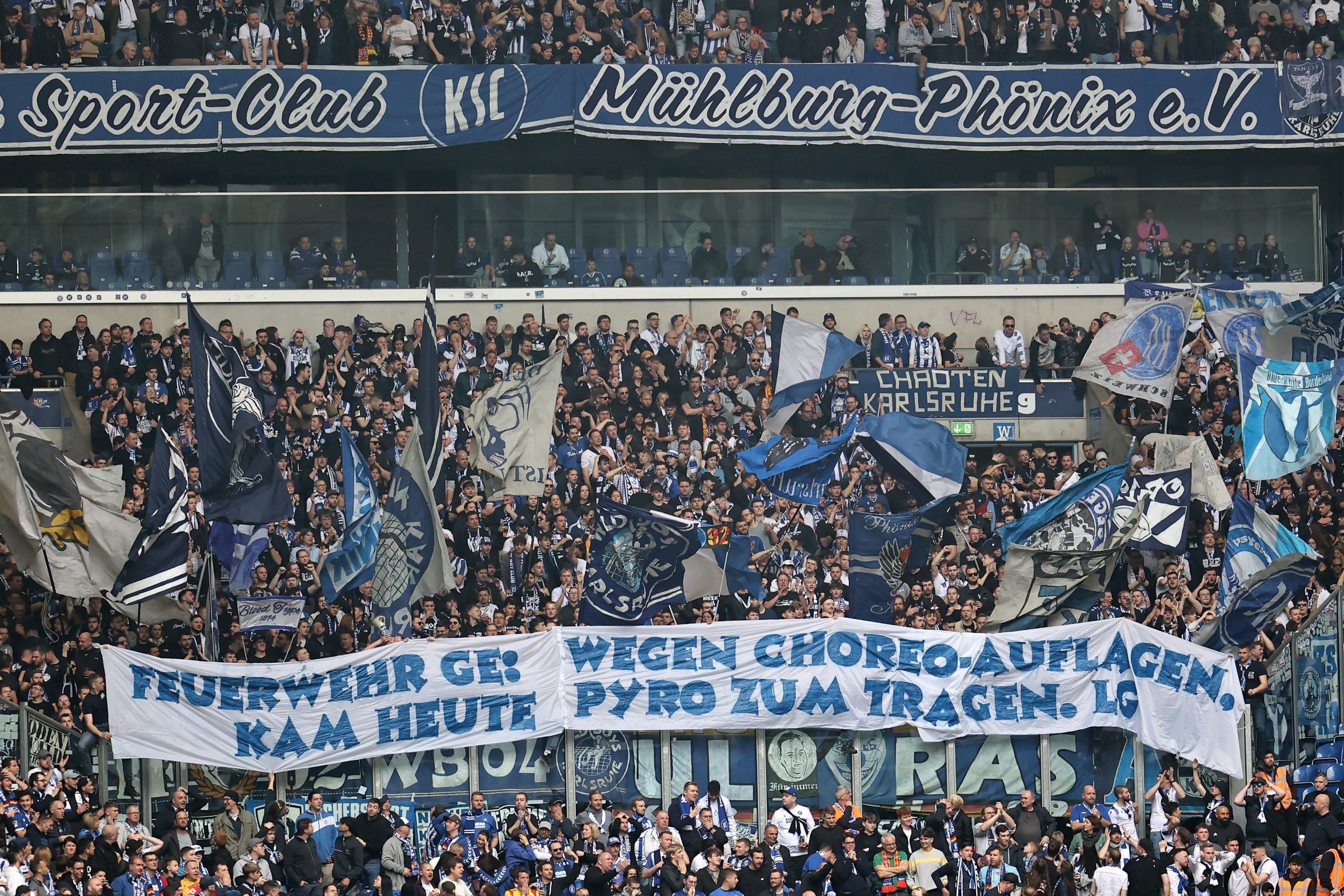
German football’s argument over stadium vloggers is no longer simply about whether supporters should be filming themselves in the stands. It is becoming an argument about what constitutes media, who gets to profit from football culture and what responsibilities should accompany the increasingly lucrative privilege of documenting it.
Last week, GGFN examined the growing conflict between organized supporters and content creators, focusing particularly on disputes in Karlsruhe and Dresden. The central question concerned ownership. Supporters create much of the atmosphere German football markets so successfully. What happens when somebody else turns that work into monetized content?
A new report from Kicker and the Deutsche Presse-Agentur widens the discussion considerably.
Two comments in particular illustrate where the debate is heading.
Germany’s “Unsere Kurve” fan alliance takes a stand
Armin Popp of the highly respected national fan alliance “Unsere Kurve” offered an uncompromising assessment of commercial stadium vlogging. His objection deserves to be taken seriously. A supporters’ end is not assembled by a production company. Its songs, flags, banners and choreographies are generally created through enormous amounts of unpaid work by people whose reward is participation in the culture itself. The problem arises when somebody else treats that culture as ready-made scenery.
“We reject the commercial exploitation of fan culture by influencers and stadium vloggers,” Popp told dpa. “The stadium is an emotional place for fans and not a TV studio or event space.”
There remains an obvious difference between a supporter taking photographs from an away trip and a creator constructing a monetized product around the people standing next to them. The camera itself is not the problem. Commercial purpose changes the equation. Dynamo Dresden has already attempted to draw precisely that distinction. Private photographs and short videos remain permissible. Commercial stadium vlogging does not, absent authorization.
Popp goes further, arguing that vloggers “have no place” within fan activity.
That position, while understandable within the context of German fan culture, is considerably harder to defend. A content creator can also be an authentic supporter who may have little-to-no commercial incentive for documenting the activities of the Kurve. Moreover, those living outside of the Bundesrepublik may thoroughly enjoy experiencing the uniqueness of what takes place within German football venues. Exposure to that culture can even encourage outsiders to travel to Germany and eventually participate in it themselves.
Thomas Horky broaches the topic of ‘journalistic rules’
Sports scientist Thomas Horky of Hamburg’s Macromedia University approaches the subject from another direction.
“There are more and more peripheral actors attaching themselves to journalism,” Horky told dpa. “That includes stadium vloggers. They do much of the same technical work as a traditional journalist. However, they do so without the appropriate training and for different reasons—primarily for self-promotion.”
Horky’s distinction is therefore not primarily about the mechanics of producing media, but about the standards and incentives behind it.
That observation should interest anyone working professionally in football media. A traditional journalist travels to a stadium, observes events, interviews people, interprets what happened and publishes material for an audience. A successful vlogger may travel to the same stadium, observe events, speak to supporters, interpret what happened and publish material for an audience.
Professional journalism carries expectations of verification, attribution, corrections, disclosure and accountability. Accreditation places journalists under rules governing where they may go, what they may film and what material they may distribute. A large audience alone does not impose equivalent obligations. Vloggers can also edit material selectively without necessarily being subject to the same editorial accountability for how events and individuals are portrayed.
Football already treats influencers as media when convenient
The contradiction becomes impossible to ignore once football’s governing institutions enter the picture. At this summer’s World Cup, FIFA provided roughly 30 global content creators with access to press conferences, training facilities and other areas ordinarily unavailable to supporters. They were not brought in to write conventional match reports.
Their purpose was precisely to create the sort of personality-driven, supporter-facing material that traditional media frequently does not produce. That tells us something important. The creator economy is not standing outside football demanding admission. Football has already opened the door.
Clubs, leagues and associations want access to younger audiences on YouTube, TikTok and Instagram. When influencers can deliver those audiences, they become valuable communications partners. The independent creator filming from the terrace can simultaneously be characterized as an unwanted commercial intruder.
There are legitimate reasons for the distinction. Accredited creators can be placed inside a controlled rights framework. Independent vloggers cannot.
But football should at least acknowledge what it is doing. Influencers cannot logically be dismissed as fundamentally incompatible with football culture while governing bodies simultaneously construct official roles for them whenever their reach becomes commercially useful.
The journalist-versus-influencer argument misses the point
Traditional sports journalism also needs to resist an easy conclusion. Vloggers are competitors for attention. That does not mean they are responsible for journalism’s difficulties. Media consumption has changed. A teenager who watches a ten-minute stadium vlog instead of reading a match report has not necessarily been stolen from a newspaper audience. That person may never have intended to read the newspaper in the first place.
Horky’s point about changing generational habits matters here. Traditional media will have to adapt without abandoning the standards that distinguish journalism from personal branding. The answer cannot simply be to insist that anyone without conventional training should remain outside the gates. Nor should football eliminate distinctions altogether.
Someone recording their own matchday memories, somebody producing a sponsored stadium vlog and a reporter attending under professional accreditation are engaged in three related but different activities. German football needs rules capable of recognizing that, preferably ones that acknowledge the differences while attempting to facilitate inclusion.
Popp and Horky can both be right
Popp’s cultural concern and Horky’s media analysis are not actually contradictory. Popp is right that supporters should not automatically become unpaid extras in somebody else’s commercial production. Horky is right that vloggers and other creators now occupy territory once reserved almost exclusively for conventional media.
Both developments require boundaries. Personal, non-commercial documentation should remain subject to different rules than commercial content. Commercial content should come with greater obligations concerning permission, rights and those being filmed. Official creator accreditation should carry rules and accountability just as journalistic accreditation does.
And organized supporters should possess a meaningful voice in protecting the culture they create without acquiring unilateral authority to decide who counts as a legitimate fan. The interesting question is therefore no longer whether stadium vloggers belong in football. They are already there. So are journalists, broadcasters, club media departments, professional influencers, hobby vloggers and thousands of supporters who happen to carry very capable cameras in their pockets.
Those distinctions matter.
Proportionality offers a better standard
Not every person uploading a matchday video is building a commercial media operation. Plenty simply enjoy documenting football, sharing trips with a small audience or introducing people elsewhere in the world to a culture they might otherwise never experience. Some will never make a cent from it, while others might recoup modest sums that help offset their travel and ticket costs. Others may gradually acquire larger audiences and commercial opportunities.
German football should be wary of drawing the line so aggressively that this kind of participation becomes collateral damage. The better approach is proportionality.
The principle is hardly revolutionary. Rules routinely become more demanding as an activity grows in scale, commercial value and potential impact on others. A hobbyist documenting an away trip for a small audience need not be treated identically to a professional creator whose business depends upon filming supporters and stadium culture.
A supporter filming for pleasure should not be treated like a broadcaster. A hobby vlogger with a modest audience should not automatically be treated like a professional influencer. And a large commercial creator using supporters, choreographies and stadium atmosphere as the raw material for a monetized product cannot reasonably insist that the same rules governing somebody’s private matchday memories should apply.
Likewise, professional journalists should not pretend that accreditation confers ownership over the act of documenting football. What it does confer are responsibilities, restrictions and accountability. That is ultimately where Popp and Horky meet and both positions can be taken seriously.
Where the debate should steer
German football does not need another argument about who is a “real fan”, who qualifies as “real media” or whether somebody with a YouTube channel belongs inside a stadium. It needs a framework capable of recognizing degrees: private memory, hobbyist creation, commercial content and professional journalism are not identical activities simply because all four may involve someone pointing a camera at the same terrace.
That framework need not be excessively complicated. Clubs can distinguish between incidental filming and sustained commercial production. Supporters can reasonably expect not to become involuntary performers in somebody else’s business model. Hobby creators should retain space to document and share football culture without automatically being subjected to restrictions designed for major commercial operators. And creators granted official access should accept that greater privileges necessarily bring greater responsibilities.
Traditional media should accept something in return. Journalism no longer enjoys a monopoly on documenting football, and accreditation should not become an instrument for protecting established outlets from new forms of storytelling.
Admittedly, that leaves plenty of difficult cases in the middle. A channel can begin as a hobby and gradually become profitable. A creator may earn enough to cover an away trip without operating anything resembling a media company. Another may have an enormous audience while producing material independently. No single follower count or revenue threshold will resolve every case.
That is precisely why proportionality is preferable to prohibition.
Blanket restrictions carry another risk as well. Part of German football’s international appeal lies precisely in the supporter culture that people encounter online before ever setting foot in the country. Videos of terraces, away ends and matchday rituals can introduce supporters abroad to something they might otherwise never see. Some will eventually decide to experience it for themselves.
If newcomers documenting that experience encounter only hostility or an impenetrable collection of unwritten rules, the very culture they travelled to appreciate can begin to appear unnecessarily closed and exclusionary. That does not mean active supporters must tolerate intrusive filming in the Kurve. Protecting fan culture and welcoming outsiders are not mutually exclusive. German football can defend the integrity of its terraces without constructing walls around them.
Indeed, the culture is worth protecting precisely because so many people want to experience it. Protection should not become enclosure. The smartphone has already made everyone a potential publisher. The camera does not determine the responsibility; scale, purpose, access and impact increasingly do.
German football’s task is therefore not to stop people pressing record.
It is to make certain that, as the audience grows and the camera becomes a business, the responsibilities grow with it.