
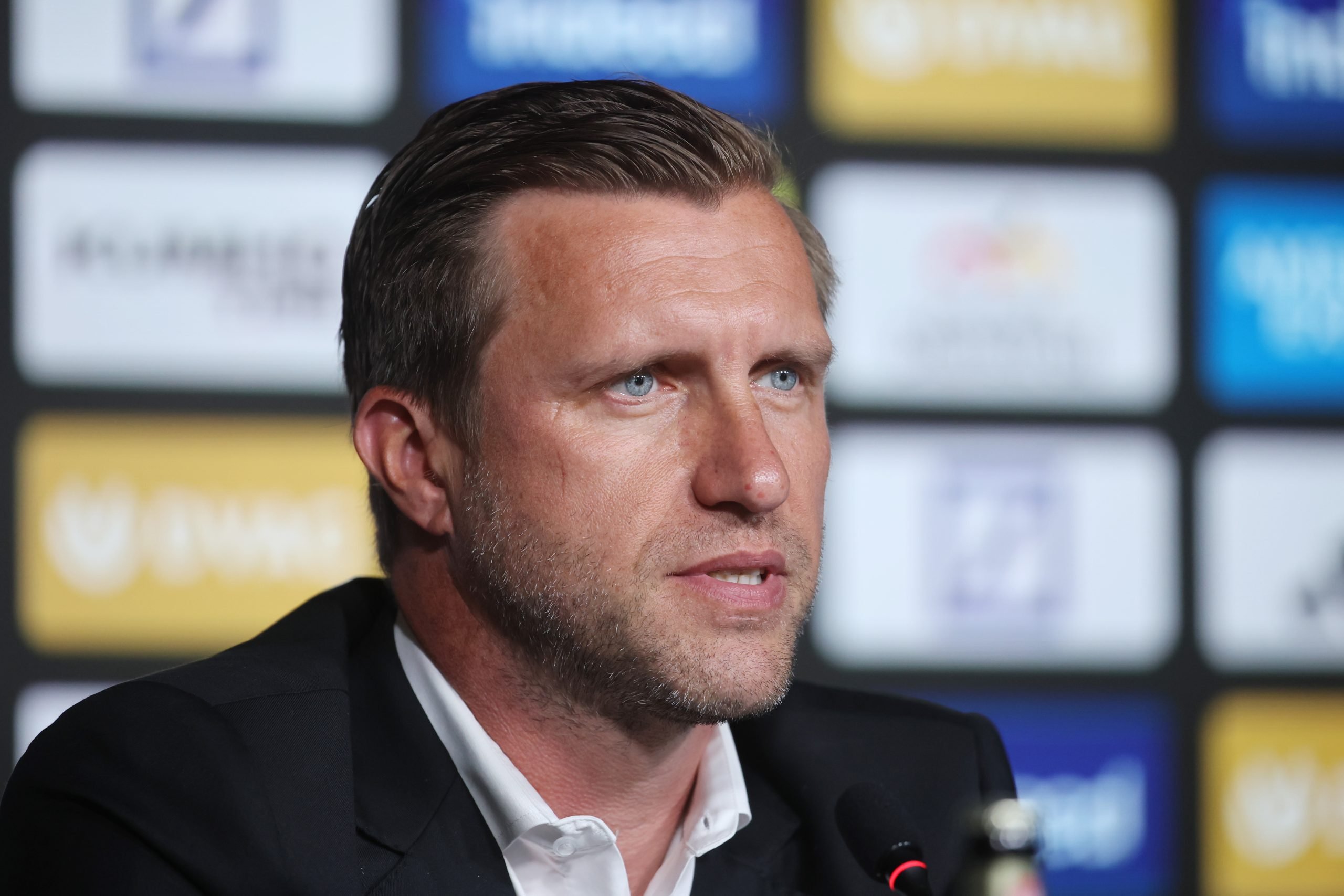
Eintracht Frankfurt’s search for a successor to departed sporting executive Markus Krösche is gathering momentum, with Southampton sporting director Johannes Spors emerging as another candidate for the position. According to Kicker, Frankfurt have already established contact with the 44-year-old, who joins RB Leipzig’s Marcel Schäfer and former Eintracht captain Christoph Spycher among the names being discussed.
Spors has served as Southampton’s sporting director since February 2025 and reports directly to club owner Dragan Solak. The German executive possesses extensive international experience, having previously worked with Hoffenheim, RB Leipzig and Hamburg in his native country, in addition to holding positions connected with clubs in Italy, Belgium, Australia, France and the Netherlands.
Kicker reports that Frankfurt’s supervisory board has been exploring potential successors for several weeks, with discussions already taking place before Krösche’s departure was officially announced on Sunday evening. The club’s three-member supervisory board executive committee, comprising Mathias Beck, Sven Janssen and Felix Wirmer, is responsible for overseeing the appointment.
Frankfurt CEO Axel Hellmann is also expected to exercise considerable influence over the decision, although the authority to appoint Krösche’s successor ultimately rests with the supervisory board.
Several candidates emerge as Frankfurt prepare for new era
Leipzig managing director for sport Marcel Schäfer is another candidate reportedly being considered. Schäfer’s name had previously surfaced during Frankfurt’s 2021 search for a successor to Fredi Bobic, as had that of former Eintracht defender Christoph Spycher. Spycher, currently working with Swiss club Young Boys, declined to comment on the latest speculation when contacted by Kicker. The Swiss newspaper Blick reports that he intends to remain in Bern.
Another individual linked with the position, Nürnberg sporting executive Joti Chatzialexiou, informed Kicker that he had not received an approach from Frankfurt. The Hessians are nevertheless expected to recruit an executive currently employed elsewhere. Kicker reports that the club’s leadership has effectively ruled out appointing an unattached candidate, meaning Frankfurt will likely have to negotiate compensation with another club to secure their preferred choice.
The uncertainty extends beyond the vacant board position. Sporting director Timmo Hardung’s future remains unclear, while further changes could follow in Frankfurt’s medical department and youth academy. The incoming executive will also be expected to begin work as quickly as possible. Frankfurt intend to provide some financial resources for the January transfer window, with additional defensive reinforcements among the squad’s most pressing requirements.
The appointment comes at an especially consequential moment for a club attempting to reverse a disappointing domestic trajectory while simultaneously reassessing the business model that helped establish Frankfurt among Germany’s leading clubs.
Krösche’s departure brings prolonged uncertainty to an end
Krösche’s separation from Frankfurt was officially announced on Sunday, October 18, bringing an end to an association that began in 2021. Although the timing initially came as a surprise, Get German Football News had already reported on the possibility of his departure in late August. At the time, reports of disagreements with returning head coach Adi Hütter had accompanied growing uncertainty surrounding the sporting executive’s position. The recently concluded summer transfer window had also exposed several problems within Frankfurt’s recruitment strategy.
A series of developments appear to have contributed to the deterioration of Krösche’s internal standing. His appointment of Albert Riera as head coach earlier this year proved especially contentious. Krösche initially defended the Spaniard following a controversial press conference, but the experiment ultimately failed to produce the desired sporting progress.
Hütter’s subsequent return also highlighted changing dynamics within the club’s leadership. According to Kicker, other influential figures within Frankfurt’s organization played significant roles in facilitating the Austrian’s comeback. Meanwhile, Krösche’s discussions with AC Milan during the summer reportedly created additional tensions.
The supervisory board was said to have learned of the Italian club’s interest through media reporting rather than directly from the executive. Another controversy concerned a Croatian property transaction involving Krösche and the wife of player agent Andy Bara. Frankfurt conducted internal and external legal reviews that fully cleared Krösche of wrongdoing. Nevertheless, Kicker reports that the failure to inform the supervisory board beforehand contributed to internal dissatisfaction.
The increasingly difficult summer transfer window compounded these concerns. Hütter reportedly became frustrated by the delayed acquisition of an experienced defender, while Frankfurt’s unresolved goalkeeping situation also attracted criticism. Ultimately, both Frankfurt and Krösche concluded that an early separation represented the best course of action.
Krösche receives emotional farewell from Eintracht supporters
Whatever disagreements characterized the closing months of Krösche’s tenure, Monday evening’s general meeting demonstrated the appreciation he had earned during his years in Frankfurt. The 46-year-old delivered an unusually emotional farewell address to approximately 1,300 assembled club members at the Jahrhunderthalle.
Krösche acknowledged that his professional demeanor could sometimes make him appear cold or detached. He emphasized, however, that this outward appearance did not reflect his feelings for Frankfurt or the significance of the club’s achievements during his tenure. The departing executive also provided a candid explanation for his decision to step away.
After reflecting on his responsibilities and the demands of the position, Krösche said he no longer believed he possessed the necessary drive and effectiveness to perform the role to Frankfurt’s required standards. He explained that a club of Frankfurt’s stature required a sporting executive capable of approaching the job with complete commitment and conviction. Having concluded that he could no longer guarantee this, Krösche approached the supervisory board’s executive committee with his request to leave.
His farewell address included affectionate recollections of Frankfurt’s 2022 Europa League triumph, the memorable European encounters with Barcelona, the club’s Champions League adventures and the 2023 DFB-Pokal final. Krösche thanked supporters for the energy and passion they had given him throughout his tenure and promised that he would always remain connected to Eintracht Frankfurt.
The assembled members responded by rising to their feet and applauding for almost two minutes. The respectful separation also leaves Krösche free to pursue another professional opportunity. Frankfurt have reportedly secured an agreement requiring his next employer to pay compensation in the region of €4m to €6m.
AC Milan remain a possible destination. GGFN reported renewed expectations of Krösche joining the Italian club on Monday, although Kicker subsequently noted that individuals close to the executive expect him to take some time away from football before accepting another position.
A remarkable transfer legacy, but not without costly mistakes
Krösche leaves Frankfurt having overseen one of the most successful periods in the club’s modern history. The 2022 Europa League triumph naturally represents the sporting highlight, but his tenure also included multiple Champions League qualifications, sustained European involvement and extraordinary revenues generated through player sales.
The club’s transfer strategy relied heavily on acquiring promising footballers at relatively modest prices, developing them into established performers, and eventually negotiating lucrative departures to wealthier European clubs. Randal Kolo Muani remains the most striking example. The French international arrived from Nantes on a free transfer in 2022 before Paris Saint-Germain paid a reported €90m base fee to acquire him just one year later.
Omar Marmoush followed a remarkably similar trajectory. Frankfurt signed the Egyptian without paying a transfer fee in 2023 and subsequently sold him to Manchester City for approximately €75m in January 2025. Hugo Ekitiké constituted another extraordinary success. Having joined from PSG through an initial loan arrangement and subsequent purchase option, the French forward developed into one of the Bundesliga’s most dangerous attackers before Liverpool paid a reported €88m for his services.
The success stories were not confined to attacking players. Ecuadorian defender Willian Pacho arrived from Antwerp for a reported €9m before leaving for PSG in a deal worth approximately €40m. More recently, left-back Nathaniel Brown developed from an inexpensive Nürnberg acquisition into a Germany international. His €50m move to Bayern Munich this summer provided another major financial windfall.
Krösche himself celebrated Brown’s transfer as recognition of Frankfurt’s developmental work, emphasizing that the club had helped produce a player capable of commanding a record-breaking fee between Bundesliga teams.
Nevertheless, the outgoing executive’s recruitment record also included expensive disappointments. Elye Wahi, signed from Marseille for a reported base fee of approximately €25m in January 2025, failed to reproduce his previous Ligue 1 form in Germany. Wahi managed only one competitive goal for Frankfurt before returning to France on loan.
He is currently spending another spell with Nice, with Frankfurt reportedly hoping the Ligue 1 outfit will exercise a €17m purchase option. Michy Batshuayi, Jens Petter Hauge, Lucas Alario and Jérôme Onguéné also feature among the unsuccessful acquisitions of Krösche’s tenure. The uneven results also illustrated the risks inherent in any recruitment strategy dependent on identifying undervalued talent and generating future transfer profits.
For several years, Frankfurt’s most successful deals comfortably overshadowed their disappointments. More recently, however, changing market conditions and sporting difficulties have forced the club to reconsider its approach.
Frankfurt leadership outlines new financial and sporting priorities
The challenges awaiting Krösche’s successor became considerably clearer at Monday’s general meeting, where CEO Axel Hellmann and supervisory board chairman Mathias Beck outlined a significant adjustment to Frankfurt’s strategy. Hellmann acknowledged that the business model underpinning Frankfurt’s recent development had changed.
The executive explained that substantial transfer revenues had enabled Frankfurt to reinvest in their squad and improve the club’s overall sporting infrastructure. However, the most recent transfer window demonstrated that generating such profits could no longer be taken for granted. Hellmann therefore called for Frankfurt to reduce their financial dependence on player sales and strengthen the club’s commercial relationships throughout the Rhein-Main region.
The strategy does not represent a complete abandonment of the club’s previous recruitment philosophy. Frankfurt still intend to identify and develop promising international players. Nevertheless, Beck emphasized that the increasing cost of young prospects, combined with a shrinking market for high-value departures, required the club to reconsider its priorities.
Frankfurt now intend to devote greater attention to the German transfer market and the development of players through their own academy. The proposed adjustments are particularly significant considering the extent of the squad’s recent turnover. GGFN’s extensive 2026/27 Frankfurt tactical preview examined how Brown’s departure and other defensive changes had left Hütter facing difficult personnel and tactical questions before the campaign had even begun.
Those concerns subsequently translated into disappointing Bundesliga performances. GGFN‘s examination of Hütter’s recurring Frankfurt problems further highlighted the difficulties facing the Austrian coach. Hütter eventually abandoned his preferred 4-2-2-2 formation in search of greater defensive stability, with the tactical adjustment producing a much-needed victory over Mainz. Krösche’s replacement must now reconcile the club’s longstanding ambitions with the practical demands of building a more stable squad.
The next sporting executive will be expected to strengthen an underperforming team, develop a more sustainable recruitment model, improve integration between the academy and senior squad, and establish an effective working relationship with both Hellmann and Hütter.
Frankfurt’s recent successes ensure that the position remains an attractive one. Yet the responsibilities awaiting the eventual appointee extend considerably further than merely negotiating the next profitable transfer.
The club’s search for Krösche’s successor therefore represents more than a change in personnel. It may also determine how Eintracht Frankfurt navigate the next phase of their development after an exceptionally successful, but increasingly difficult, five-year period.