


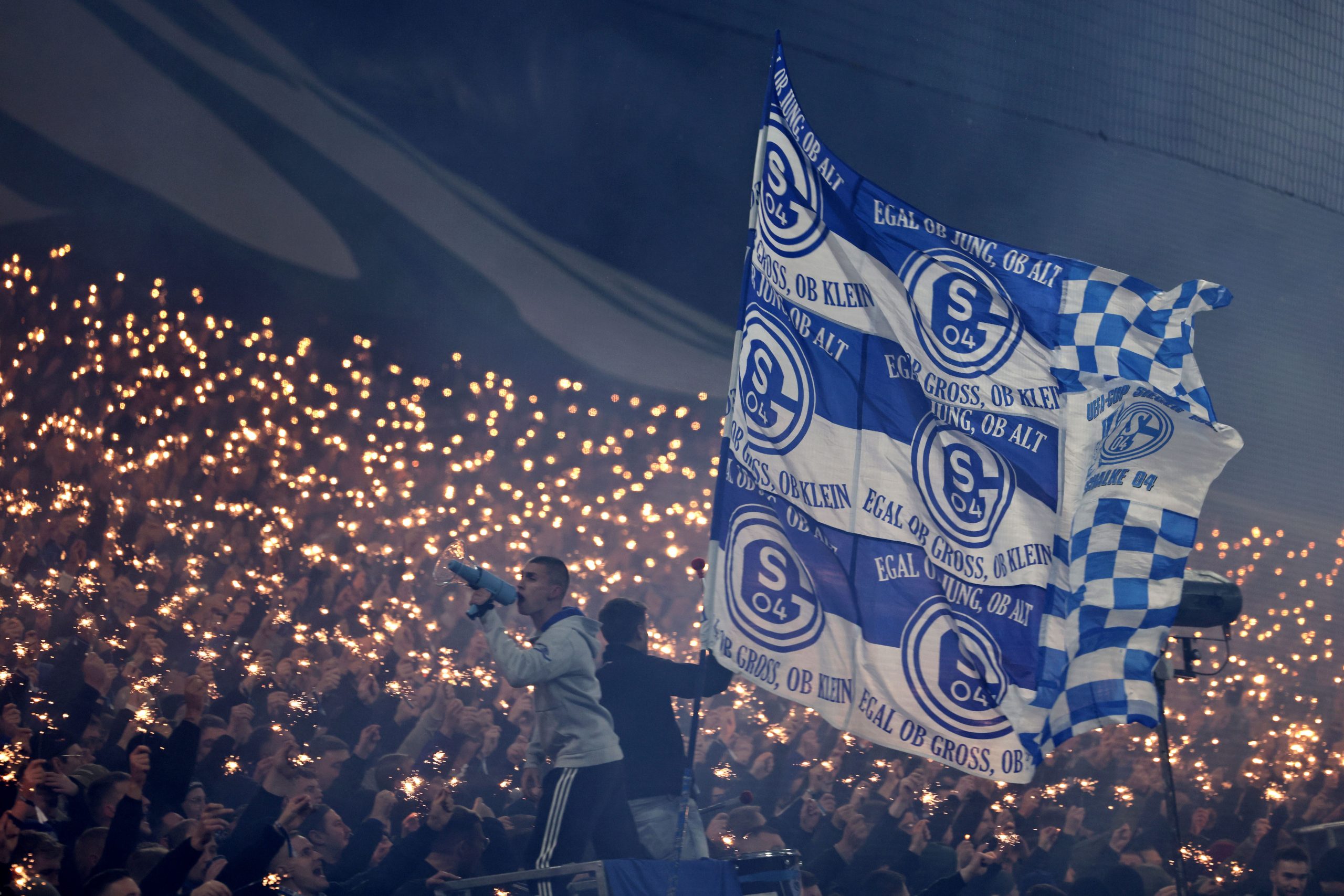
The penultimate installment of our Get German Football News Bundesliga 2026/27 Tactical Previews tackles our third and final Bundesliga newcomers: FC Schalke 04. This club obviously deserves different treatment than “Graue Maus” organizations such as Elversberg or Paderborn. The “Big Blue” elevator is coming back up. No one really needs a reminder of what Schalke’s last two Bundesliga years produced. The author simply can’t resist taking a quick stroll down memory lane anyway. Schalke’s transformation from a reliable Bundesliga mainstay to a “Fahrstuhl Mannschaft” deserves some documentation.
The 2020/21 model spent seven months refusing to move at all, cycled through five different coaches, and eventually required until April to record its second Bundesliga victory of the entire season. David Wagner went. Manuel Baum came and went. Huub Stevens briefly wandered back through the building. Christian Gross had a turn. Dimitrios Grammozis became coach number five. At some point, Schalke ceased resembling a football club and began resembling one of those emergency-management exercises in which participants are deliberately given increasingly ridiculous problems to see when they finally begin screaming.
Relegation eventually arrived. Naturally, Schalke responded by immediately winning the 2. Bundesliga. Up came the elevator. The doors opened. Everyone stepped back inside. The 2022/23 Bundesliga campaign initially appeared determined to prove that the machinery had not actually been repaired. Schalke spent months at the bottom and went more than 400 league minutes without scoring. Then Thomas Reis somehow got the thing moving. They stopped losing for eight matches. Then they finally won away from home for the first time in 38 league attempts, appropriately enough at Reis’ former club Bochum.
There was the 5-2 demolition of Hertha. There were frantic relegation six-pointers. There was hope. There was pain. There was more hope, which was frankly irresponsible. There was a final afternoon in Leipzig during which Schalke fought, scored twice, briefly gave themselves something to believe in and were relegated anyway. Down went the elevator. The author watched the doors close. Three years passed. Ding. Up they came again. New trainer Miron Muslic turned them into aggressive, compact, transition-heavy 2. Bundesliga champions.
Under the stewardship of highly competent former Werder Bremen executive Frank Baumann, former Schalke “Eurofighter” Youri Mulder, and (most recently) awesome new scouting department head appointment Maximilian Lüftl, the 2. Bundesliga champions stand an excellent chance to replant a permanent Bundesliga flag. The supporters, meanwhile, have responded to promotion with their customary moderation. Roughly 40,000 away shirts disappeared in two-and-a-half hours this summer. Muslic’s team looks good. The debt incurred during the COVID crisis (the real reason for Schalke’s downfall) has been reduced by half. The author genuinely feels as if this S04 incarnation can go a long way towards erasing all those recent memories.
Welcome back to the Bundesliga, Königsblauen!
Schalke 04
Before getting to the actual team on the pitch, we’ll briefly return to the debt issue. Schalke’s Bundesliga promotion is actually forecast to put the club slightly in the red this year. Slightly higher transfer fees and bonuses built into existing player and staff contracts played a role, as did the fact that a few longstanding corporate bonds came due. Trainer Miron Muslic – himself one of the big beneficiaries of said bonuses – must make do with some targeted acquisitions.
The transfer market has therefore been less about building a new Schalke than about making the existing one harder to break. That has worked rather well on paper and certainly proved intriguing in practice. Before getting into what Muslic actually did with all of these moving parts during pre-season and in the Pokal, it is probably worth inspecting the receipts and seeing just how much Bundesliga Schalke managed to purchase for surprisingly little money.
Major personnel shifts, Schalke
Estimated Summer Transfer Balance = -€2.75m
Schalke did not respond to promotion by attempting to purchase an entirely new Bundesliga team. That would have been expensive, disruptive and, given what Miron Muslic had just accomplished with the existing group, rather silly. Instead, the champions spent remarkably little while trying to raise the quality around the structures that already worked. Midfielder Satoshi Tanaka cost just €1m. Eric Junior Dina Ebimbe and Junior Adamu were procured for just €800,000 apiece. Maximilian Wöber came from Leeds on a free and Robin Gosens joined on loan from Fiorentina. For a promoted club adding several players with legitimate starting potential, this is less a spending spree than an aggressive raid on the discount aisle.
Contract extensions for striker Edin Dzeko, left-back Vitalie Becker, midfielder Soufiane El-Faouzi, and center-back Mertcan Ayhan were all completed over the course of the offseason. This administrative team truly worked well on all fronts. Dina Ebimbe – for all his issues – brings pace, Bundesliga experience, and great positional flexibility. Gosens, if he can remain fit, constitutes a wonderful find that adds leadership, enthusiasm, and precisely the sort of attacking prowess that suits Muslic’s preferred three-man defense. The midfield business may prove even more important. Tanaka immediately began pushing Ron Schallenberg in midfield.
The center of defense received experience rather than an obvious new first-choice guarantee. Wöber possesses enough Bundesliga and international pedigree to challenge immediately if his body cooperates. That last clause, naturally, remains rather important. Adamu brings pressing, depth running and Bundesliga experience rather than guaranteed finishing. There is some unfinished work heading in the opposite direction. Schalke have earned only around €200,000 in listed outgoing fees, from Ilyes Hamache’s move to Cambuur, while much of the attempted squad reduction has instead involved loans, expired contracts and demotions to Schalke II.
Martin Wasinski and Mauro Zalazar returned from loans only to drop out of the Bundesliga group, while Anton Donkor remains among the players the club would still prefer to move. The task is therefore no longer primarily to find another half-dozen footballers. It is to finish trimming the squad without accidentally creating another hole by selling somebody Muslic actually needs. That distinction matters because Schalke’s summer has been less about reconstruction than targeted reinforcement of a functioning promotion team.
Overall, Baumann and the front office have had a banger of a summer. Gosens and Dina Ebimbe improve the wing-back positions. Tanaka raises the midfield floor. Wöber adds experience. Targeted contract extensions secure the backbone of the team. The transfer bill remains almost comically small for the amount of possible Bundesliga usefulness acquired. That is the good news. The less comforting part is that inexpensive recruitment comes with a fairly obvious condition.
Quite a lot of it now has to work.
Notes from pre-season, Schalke
Against Regionalliga side FC Gütersloh, the first iteration was a 4-3-3, aggressive and high without the ball, with Moussa Sylla repeatedly trying to start his runs on the shoulder of the final defender. Occasionally he started them approximately three centimeters too early. Karaman moved far more freely, drifting between central and wider attacking zones instead of behaving like a conventional winger. After halftime, personnel changes altered the structure toward something closer to a 4-2-1-3, with Janik Bachmann making increasingly aggressive runs into the penalty area.
For a first friendly, there were recognizable Muslic ideas. There was also a 1-2 defeat. Gütersloh scored first after a long throw was flicked on inside the area, then doubled the advantage when backup keeper Kevin Müller produced the kind of buildup mistake goalkeepers generally prefer to store in the July folder and never reopen. Müller partially redeemed himself by saving a stoppage-time penalty, while Aouchiche curled in a direct free kick moments earlier for Schalke’s only goal.
One week later at Erzgebirge Aue, Muslic made the geometry considerably more interesting. Off the ball, Schalke again resembled a 4-3-3. With the ball, however, the shape folded inward into a 4-4-2 diamond. Ron Schallenberg anchored the base. Aouchiche and Soufiane El-Faouzi occupied the two eight positions. Squad captain Kenan Karaman played at the tip behind Sylla and Junior Adamu, while the nominally wider attacking players moved inside and left the full-backs responsible for supplying the actual width.
It was an elegant solution to a squad containing plenty of central attackers and relatively few natural wingers. It also suited Sylla. The Malian striker headed Schalke ahead after a move through El-Faouzi and Aouchiche, then reacted fastest immediately before halftime to make it 2-0. Muslic replaced the entire team at halftime and the reserves immediately extended the lead through Christian Gomis and Bryan Lasme, although Lasme managed to miss a penalty shortly before scoring from distance. There were some issues in maintaining the shape.
The first stronger benchmark came three days later against Metalist Kharkiv. Muslic kept most of the first group together, brought Satoshi Tanaka into midfield and gave the starters an hour rather than another half. Schalke controlled much of the match, ran aggressively and immediately hunted the ball after turnovers, but initially struggled to turn territorial superiority into clear chances. That changed after halftime. Sylla scored the opening goal in the 54th minute.
Muslic again changed the entire team after an hour. This time there was no collapse in structure. The second XI continued controlling the game, Lasme scored within three minutes of coming on and Schallenberg later struck the crossbar. More importantly, Schalke’s intensity now looked transferable between two different groups.
The final match of the Austrian camp against Fagiano Okayama finally brought the system everyone expected to see. Muslic switched to a three-/five-man defense, Robin Gosens made his Schalke debut on the left, and Dejan Ljubicic filled the unresolved role on the opposite wing. This was closer to the intended Bundesliga geometry. Okayama initially made it look uncomfortable.
The Japanese first-division side moved the ball sharply through short combinations and caught Schalke on a counter from a corner for the opening goal. It was a good early illustration of the risk attached to pushing both wing-backs forward. Schalke recovered through Hasan Kuruçay. The center-back headed in Aouchiche’s corner, then controlled another Aouchiche cross inside the penalty area and was fouled while turning. Karaman converted the penalty.
Sylla should probably have added another, but missed twice before the break. Junior Adamu eventually scored his first Schalke goal after coming on, sealing a 3-1 win. The more consequential event occurred elsewhere. Adrian Gantenbein entered at halftime, was injured during a defensive action and had to leave again. Initial optimism after the game did not survive the subsequent diagnosis; the injury became serious enough to transform an already questionable right wing-back position into a transfer priority.
Schalke had already tried Becker there. Then Ljubicic. They would later try El-Faouzi. At some stage, moving every central midfielder in the squad to right wing-back ceases to qualify as squad planning and becomes performance art. The next friendly against Hessen Kassel demonstrated both how the system was settling and how quickly injuries could complicate it. Schalke worked primarily from a flexible 3-4-2-1/3-4-1-2, with Aouchiche repeatedly moving into central creative areas behind the strikers.
Karaman opened the scoring from Schallenberg’s pass. Vitalie Becker, introduced after Gosens was forced off early, crossed for Adamu to make it 2-0. Aouchiche scored the third. Sylla added the fourth. Tanaka made it five from distance. Of course, the opponent was a Regionalliga side. The personnel experiments were more important. Maximilian Wöber entered as the left-sided center-back in the three. El-Faouzi finished the match at right wing-back and still supplied Tanaka’s goal.
Then the opponents became serious.
Very serious. Atalanta came for a visit in front of almost 59,000 supporters, and the first genuine elite-level test finally exposed the margins that had largely remained theoretical against lower opposition. Schalke lost 0-3. They were not outplayed 0-3. That distinction matters. New signing Eric Junior Dina Ebimbe immediately started on the right and chased down a long ball before crossing for Karaman, whose header narrowly cleared the bar. Adamu then received a gift after Atalanta lost the ball in buildup and shot wide.
Schalke were creating. Atalanta were finishing. Gianluca Scamacca punished the first major defensive opening and made it 1-0. Then came the sequence of the summer. Aouchiche delivered a corner. Karaman rose and headed the ball against the crossbar and then the post. Former Hertha and Leipzig man Lazar Samardžić cleared off the goal line. Schalke were perhaps ten centimeters from 1-1. Samardžić then collected himself, carried the ball almost the entire length of the pitch, ran straight through Schalke and finished at the opposite end. 0-2.
Football remains extremely committed to slapstick when it senses vulnerability. The sequence also illustrated the Bundesliga problem more effectively than several pages of tactical theory could. Losing the second ball against Regionalliga opponents might create a recoverable transition. Losing it against Samardžić creates a 70-meter solo goal. Adamu continued getting into good positions after halftime and continued failing to score from them. There was a certain cruelty to it because everything except the final action looked promising. Adamu’s movement and aggression made him look like a promising recruit.
One week later, Real Madrid arrived and conducted roughly the same experiment with more expensive equipment. Schalke again lost 0-3. Karaman, Gosens and Dina Ebimbe were all unavailable, so Muslic started Sylla and Adamu together in a two-striker variation of the three-/five-man structure. Dzeko, Tanaka and Wöber began on the bench. For the opening minutes, Schalke were energetic enough to make the hometown crowd believe. Then Ron Schallenberg delivered an exquisite through ball for Kylian Mbappé. The wretched back-pass made it 0-1 with six minutes gone.
Real’s second arrived when Dean Huijsen climbed comfortably above Sylla at a corner and headed home. The striker-versus-center-back aerial matchup did not survive peer review. Schalke continued competing. Sylla attempted a bicycle kick. Aouchiche curled an effort toward goal. Karius made an excellent one-handed save from another Huijsen header. Timo Becker spent much of the evening repeatedly chasing Vinícius Júnior across the right side of Schalke’s defense and, improbably enough, repeatedly catching him.
He cleared one Vinícius effort near the goal line. He recovered against him again later. Then again. By the closing stages, the crowd had moved from appreciative applause to full “Timo Becker” chants every time the Brazilian discovered the same German defender appearing beside him once more. Vinícius Júnior has encountered worse opponents. He has probably encountered fewer who looked quite so pleased about the assignment.
The performance was tactically significant beneath the comedy. Schalke’s central-defense group contains plenty of aerial power and aggression, but not an abundance of recovery pace. Becker possesses more of it than most. The packet already identified that as one of the reasons he can be valuable on the right of a back three or in a more conservative wide role. Against arguably the world’s most frightening open-field left winger, he supplied the best possible audition.
Real added a third after halftime through Carlos Espí, but Schalke still created one excellent opportunity of their own. Aouchiche stole possession from Federico Valverde, released El-Faouzi toward the byline and Sylla received the cut-back at a difficult angle. Andriy Lunin saved.
The final two friendlies therefore finished:
Schalke 0-3 Atalanta
Schalke 0-3 Real Madrid
Six conceded. None scored.
And yet, they were probably the most encouraging results of the preparation campaign. Against Atalanta, Schalke nearly equalized and conceded ten seconds later. Against Real, one careless back-pass became Mbappé running alone at Karius. Against both, chances that might have been enough to decide promotion-season games disappeared without reward. The elite friendlies asked some important questions. Muslic’s tactical work across the summer consequently made sense.
And Becker apparently decided to spend the Generalprobe personally irritating Vinícius Júnior.
Cool!
Winners from camp, Schalke
Moussa Sylla, CF
Sylla spent the summer doing his best to make Schalke’s willingness to sell him rather awkward. The Malian had already finished the promotion campaign strongly and then reinforced his sporting case throughout preparation. He repeatedly threatened the defensive line against Gütersloh, scored twice against Aue and supplied perhaps the purest Muslic goal of the summer against Metalist Kharkiv: high recovery, immediate vertical pass, run in behind, finish. His pace and willingness to attack depth give Schalke something none of the other centre-forwards replicate quite as naturally. Edin Dzeko offers experience and Junior Adamu greater pressing flexibility, but while Sylla remains in Gelsenkirchen, he currently looks the strongest candidate to start. The only person apparently less convinced than the coaching staff may be the transfer department.
Adil Aouchiche, AM
Aouchiche entered summer as one of the front office’s successful winter signings and leaves it looking increasingly central to how Schalke want to create. The Frenchman repeatedly found useful spaces throughout preparation, supplied dangerous set pieces and looked especially comfortable once Muslic returned to the 3-4-2-1. The left half-space allows him to receive between the lines, combine with Karaman, Gosens and the striker and generally avoid being asked to impersonate a touchline sprinter. Schalke’s determination to extend his contract through 2029, complete with a proposed salary increase, further underlines how much his standing has risen. Aouchiche’s summer strengthened an already convincing case.
Dejan Ljubicic, CM/RWB
Ljubicic did not necessarily win one position. The former Köln mainstay won several ways to remain involved. Schalke used him centrally, at right wing-back and in wider attacking areas, with Muslic repeatedly leaning on the Austrian whenever the shape changed. The arrival of Dina Ebimbe means Ljubicic is no longer the preferred solution on the right, but his usefulness may actually have become clearer because of it. He can cover six, eight, wing-back and an advanced right-sided role without forcing Schalke to redesign the entire structure. Add four goals and three assists from 15 appearances during the promotion run and this is not empty versatility either. Muslic has a Swiss Army knife. Happily, it also occasionally scores.
Luca Vozar, CM
Vozar’s victory was quieter but no less legitimate. The former U19 captain did not suddenly leap over Tanaka, El-Faouzi, Schallenberg and Ljubicic in the midfield hierarchy. He did, however, earn a permanent place in the professional group rather than merely spending summer as convenient training-camp furniture. For a 19-year-old academy midfielder entering Schalke’s first Bundesliga season back, that qualifies as progress. Not every camp winner needs a starting shirt. Sometimes avoiding being politely returned to the youth dressing room is sufficient.
Timo Becker, CB/RB
Becker’s case is considerably easier to explain. He spent the Generalprobe personally irritating Vinícius Júnior. Becker repeatedly chased him down. Once. Then again. Then again. He cleared danger near the goal line, recovered from positions in which most defenders would already have begun negotiating with fate and eventually had the Veltins Arena chanting his name every time Vinícius discovered, presumably with increasing annoyance, that the same German defender had materialized beside him yet again. Schalke need somebody willing to chase fast people into open grass. Becker has volunteered.
Losers from camp, Schalke
Bryan Lasme, CF
Bryan Lasme – whom the author fondly recalls from his “Breathe Right” nasal-strip Bielefeld days – actually did enough to qualify as one of Schalke’s pre-season winners before his body rather rudely removed him from the conversation. For a player whose Schalke career has repeatedly been interrupted by injuries, this was beginning to look like a particularly well-timed healthy summer. Then came another muscular problem. Lasme has suffered a calf injury and is now sidelined for an indefinite period, which rather neatly recreates the availability concern that has accompanied him for much of his time in Gelsenkirchen. Damn. No nasal strips for us!
Adrian Gantenbein, RWB
Adrian Gantenbein entered camp with perhaps the clearest opportunity of anyone in the squad. Schalke already knew the right wing-back position needed work, but there was no established newcomer standing between the Swiss defender and a meaningful Bundesliga role. Muslic tried different shapes, different personnel and different ways of supplying width from that side. His serious ankle injury against Fagiano Okayama ended that opportunity and accelerated Schalke’s search for another solution. Ebimbe appears to be it. Double damn. So much for this 25-year-old’s Bundesliga dreams.
Mauro Zalazar, DM/CM
Zalazar returned from Braga’s U23 side with a theoretical opportunity to force himself back into Schalke’s senior plans. In practice, the midfield moved in the opposite direction. Tanaka arrived, El-Faouzi extended through 2030, Ljubicic remained valuable across several roles and even Luca Vozar earned a permanent place with the professional group. Zalazar has instead been reassigned to Schalke II. At 21, that does not necessarily close every future door, but it settles the immediate question rather firmly. Whatever path Schalke envisage for his development, it does not currently involve Muslic’s Bundesliga midfield.
Martin Wasinski, RB/CB
Martin Wasinski returned from his loan at RFC Liège facing much the same challenge and reached much the same destination. The Belgian defender needed a convincing summer to establish some kind of route into the senior defensive rotation. Instead, he has been assigned to Schalke II. The competition scarcely helped. Timo Becker strengthened his case throughout preparation and Maximilian Wöber arrived with Bundesliga and international experience. There simply was not enough room for Wasinski to force his way through. Pre-season offered the audition. The Bundesliga squad moved on without him.
Tactical scout, Schalke
The first competitive match promptly asked Schalke a rather different question than Atalanta and Real Madrid had. Those two elite opponents wanted the ball. Halle did not. Much of pre-season had encouraged the belief that Muslic’s football could remain useful against technically superior opposition. Schalke could press, recover, transition and make better teams uncomfortable without pretending they intended to dominate possession. The DFB-Pokal opener instead handed the Bundesliga newcomers the ball, retreated into a compact block and politely invited them to demonstrate what they planned to do with it.
For 45 minutes, the answer was not very much. Muslic began with the structure toward which most of preparation had ultimately been pointing. Schalke lined up in a 3-4-2-1, with Ron Schallenberg and Soufiane El-Faouzi in midfield, Dejan Ljubicic and Adil Aouchiche working behind Moussa Sylla and new signing Eric Junior Dina Ebimbe immediately taking over the troublesome right wing-back position. Vitalie Becker deputized for the still-recovering Robin Gosens on the opposite side.
Lineup–S04 (DFB-Pokal)
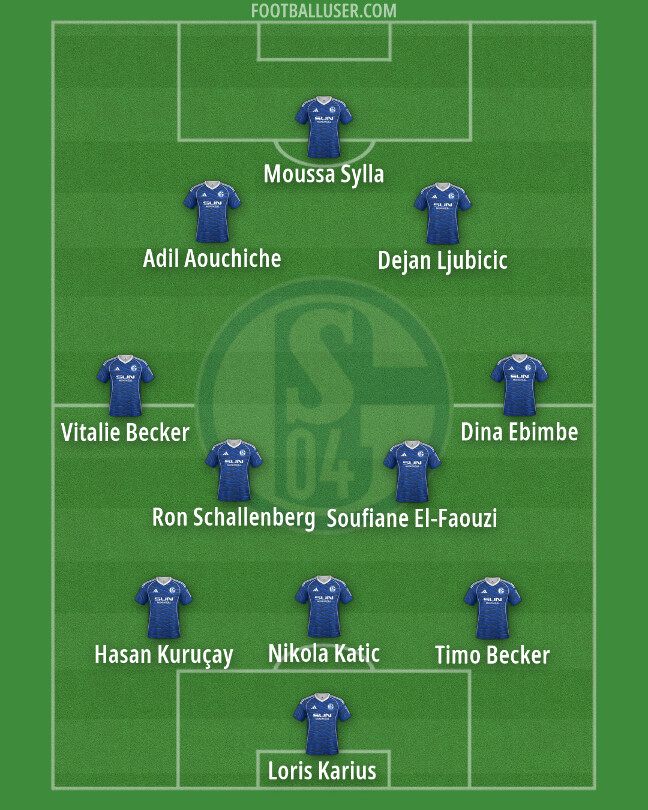
The selection furnished some rather interesting answers for those of us trying to ascertain the pre-season hierarchy. Dina Ebimbe walked directly into the vacancy Schalke had spent most of summer attempting to fill. Gosens remained short of starting fitness. Satoshi Tanaka, despite his excellent preparation, did not displace Schallenberg. Aouchiche remained the chief creative reference. Sylla remained the striker. The shape was familiar. The problem was the match.
Halle defended deep enough that Schalke accumulated approximately three quarters of the possession without receiving many of the transition situations upon which last season’s championship had been built. By the half-hour, Königsblau were sitting on 76 percent of the ball. The scoreboard remained stubbornly unimpressed. Aouchiche supplied most of what little incision existed, repeatedly drifting into the left half-space and occasionally carrying the ball all the way toward the byline. Vitalie Becker also supplied much of the width and forward running from that side.
There were crosses.
There were shots.
There was quite a lot of possession.
There were remarkably few reasons for Halle goalkeeper Moritz Bendel to begin reconsidering his evening plans.
Sylla produced the best chance after El-Faouzi found him free inside the area, but shot centrally. Aouchiche forced Bendel into a save. Becker accidentally clipped the top of the crossbar with a cross. Otherwise, the Regionalliga defense remained compact enough to keep the Königsblauen from getting the coveted opener. Halle broke quickly whenever the visitors surrendered possession. Timo Becker collected an early yellow stopping one counter. Vitalie Becker later required an excellent recovery run after another attack collapsed.
The same spaces visible against stronger pre-season opponents existed here too. Halle simply possessed considerably less quality with which to exploit them. Then came a corner. Vitalie Becker failed to clear. Vin Kastull finished. The underdogs claimed an unexpected 1-0 lead just before it was time to head into the tunnel. A team that won promotion by taking the ball away from opponents and immediately attacking them had spent a half being asked to unlock a low block, failed, and conceded from a set piece instead.
Muslic reacted immediately.
Junior Adamu replaced the anonymous Dina Ebimbe at halftime.
Ljubicic moved onto the right wing-back position vacated by the former Frankfurt man, while Adamu occupied the advanced role Ljubicic had left behind. The 3-4-2-1 remained in place while the attacking emphasis changed. Schalke pushed Halle progressively deeper, though the clear chances initially remained scarce. Katic headed narrowly wide. Sylla again found Bendel rather than the corner. Aouchiche and Adamu combined more regularly inside. Finally, in the 62nd minute, Adamu shifted possession left to Aouchiche, whose delivery survived a defensive slip and reached the arriving Ljubicic.
The emergency wing-back had travelled rather a long way from his emergency wing.
1-1.
Two minutes later, Muslic abandoned the original geometry altogether. Katic came off for Edin Dzeko. Gosens replaced Vitalie Becker. Schallenberg dropped out of midfield and into central defense as Schalke moved into a center-heavy 4-3-3. There it was. All those early summer experiments had apparently not been recreational.
Lineup–S04 (65th minute)
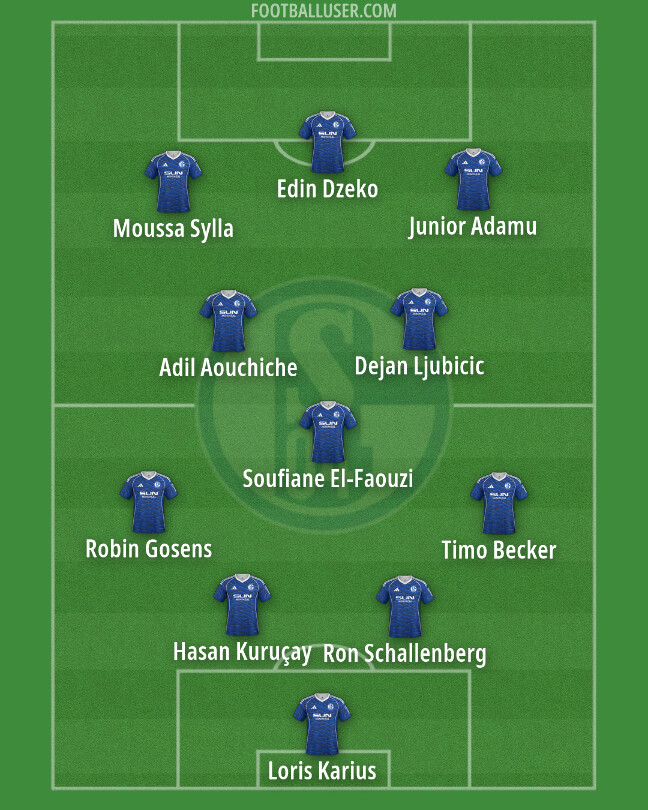
The significance went beyond adding another striker. Muslic had begun the match with three center-backs, two wing-backs and one conventional nine. He now removed one central defender, converted the back line into a four, added Dzeko to an already attack-heavy structure and trusted the remaining midfielders to keep feeding the centre. This was precisely why the pre-season experiments mattered.
Schalke’s identity did not change.
Their geometry did.
Dzeko almost announced himself immediately with an awkward falling effort before Sylla earned a penalty in the 80th minute. The Bosnian took responsibility and converted with the sort of uncomplicated certainty one occasionally gets after scoring professional goals since approximately the invention of television.
2-1.
That should have ended matters. Naturally, it did not. Muslic attempted to secure the lead in the closing minutes by introducing Mertcan Ayhan for goalscorer Ljubicic. Schallenberg consequently returned to midfield, allowing a more conventional defensive line to reform behind him. The idea made sense. The execution did not.
Instead of killing the match, Schalke retreated. Halle suddenly began attacking again. Karius had to save from Atilgan in the 90th minute. One minute later, another corner reached Niclas Stierlin, whose effort took a deflection off El-Faouzi and beat the goalkeeper.
2-2.
For all the summer work devoted to creating alternative attacking structures, the first competitive match had now exposed two separate problems. Schalke initially struggled to create when forced to dominate possession. Then they struggled to control the game once they had finally taken the lead. A Regionalliga opponent had successfully asked both questions.
Extra time finally supplied the answers Schalke’s individual quality should probably have provided much earlier. And much of it came through Dzeko. El-Faouzi found him near the penalty area in the 98th minute. Rather than turning toward goal, Dzeko redirected the ball first-time into Sylla’s path. Sylla finished directly into the bottom corner. It was a wonderfully simple combination.
It was also a useful reminder that Dzeko’s value to this squad cannot be measured merely by asking whether a 40-year-old can start every Bundesliga weekend. Schalke possess younger forwards who can run harder. Sylla can attack more space. Adamu can press more aggressively. Dzeko can simply make the correct footballing decision slightly faster than everyone else.
The same group combined again for the fourth. Dzeko helped move the ball toward Sylla on the left, the Malian controlled and lifted an excellent cross into the middle and Adamu arrived to head home. Sylla had now won a penalty, scored and assisted. Adamu had turned a difficult first competitive outing into a goal. Dzeko had scored once and materially influenced two more.
Gosens eventually supplied the veteran with the cross from which he scored his second and Schalke’s fifth. 5-2. Twenty-six shots. 74 percent possession. 4.18 xG. Those numbers make the evening look considerably more straightforward than it was. Schalke were behind after 45 minutes. They were drawing after 90. They became the only Bundesliga club in the opening Pokal round forced into extra time before finally allowing the difference in individual quality to become visible.
The match nevertheless provided an unusually useful competitive conclusion to the summer. The 3-4-2-1 is the base. When the base structure failed, Muslic first redistributed personnel inside it. When that remained insufficient, he changed the back line and flooded the center. When Schalke finally took the lead, he changed the defensive balance again. Not every adjustment worked. That may be the most useful information of all.
Pre-season demonstrated that Schalke can make stronger opponents uncomfortable so long as their pressure, spacing and transition defense remain precise. Halle demonstrated that Bundesliga life will occasionally require something entirely different: patience with the ball, creativity against a low block and enough control to finish matches after finally breaking one open.
Muslic spent summer adding geometry without sacrificing identity.
His first competitive match required nearly all of it.
And 120 minutes later, the elevator was still going up.