


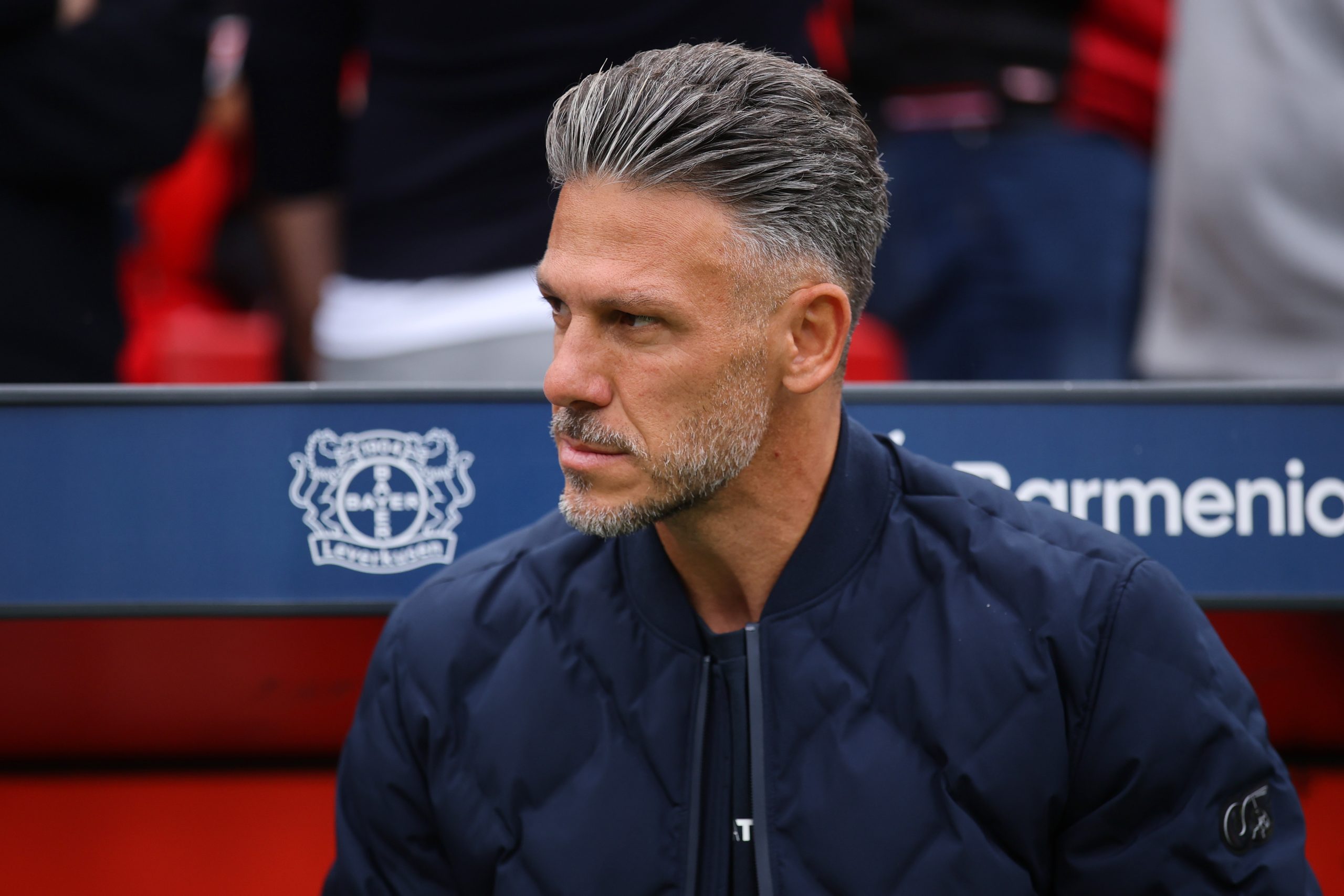
Four Bundesliga fixtures into the Martín Demichelis era, RB Leipzig have already found an impressively efficient way of making the author look both prescient and foolish at the same time. We’ll call it a draw. Those who read our 2026/27 RB Leipzig pre-season primer will recall that Demichelis’ new 4-3-3 produced some genuinely exciting football over the summer. The problem concerned sustaining it. Leipzig’s excellent six-minute spell against Bayern in the Telekom Cup yielded a rather obvious question: could this team eventually stretch six good minutes into 90?
The answer presently appears to be “depending on where they play”. Leipzig have won both of their home league fixtures by an aggregate score of 8-0. Away from the Red Bull Arena, RB have lost 1-3 in Bremen, 1-4 to Como in the Champions League and 0-2 in Leverkusen. One could naturally solve this tactical conundrum by petitioning the DFL and UEFA to allow Leipzig to play every match in Saxony. Demichelis, who is already catching his fair share of harsh flak in the German press for his German, may wish to personally spend a few hours honing the petition.
The author suspects that application may be denied.
With that in mind, we might as well delve into the football.
Interesting Developments, RB Leipzig
Nusa grabs hold of the attack
Antonio Nusa has very quickly become one of the most important players in this team. Perhaps, in the absence of Christoph Baumgartner, the most important attacking player. The Norwegian is off to a rollicking start that echoes his 2024/25 campaign. Beyond the raw production numbers, Nusa seems the player most capable of breaking out whenever the Red Bull mechanisms begin to seize up. He can simply take the ball and make the structure considerably less relevant.
The Norwegian scored on the break against Gladbach, repeatedly drove through Como defenders during Leipzig’s otherwise frustrating Champions League opener and enjoyed a starring role in the 5-0 demolition of Hamburg, earning Man of the Match honors for his role in three of Leipzig’s five goals. This matters because Leipzig have not yet consistently demonstrated that they can create openings against compact defensive blocks.
Whenever the central lanes close, the ball tends to migrate outward. Crosses follow. Possession increases. Danger does not necessarily accompany it. Nusa offers a handy alternative to all that. Namely, dribble past someone. Football occasionally remains reassuringly uncomplicated, despite what the partially insane data revolution may have us believe. Demichelis clearly doesn’t need to wrap his tongue around complex German to motivate this player.
Banzuzi becomes Demichelis’ midfield chameleon
Ezechiel Banzuzi’s strong pre-season already earned him a prominent place in our summer assessment. What has happened since, however, has been a little more interesting than a simple rise up the pecking order. Demichelis keeps moving him. Once Nicolas Seiwald returned during pre-season, Banzuzi was freed from deeper midfield duties and began operating as an aggressive eight.
That version of the Dutchman carried straight into the Bundesliga opener. Against Gladbach, Banzuzi repeatedly abandoned conventional midfield spaces altogether, attacking the box and occasionally popping up in areas one normally reserves for the centre-forward. The role has hardly remained fixed since.
Banzuzi continued as an advanced midfielder in Bremen. In Como, Demichelis introduced him as part of the highly aggressive second-half reorganisation that left El Aynaoui holding midfield largely by himself. Against Hamburg, Banzuzi again pushed high and wide enough to become part of the attacking line, bursting down the right to supply Gomis for the opener.
Then came Leverkusen. Rather than deploying Banzuzi as the roaming eight seen for much of the summer, Demichelis dropped him alongside El Aynaoui in the 4-2-3-1 double pivot. The 20-year-old suddenly found himself responsible for much more conventional midfield work before Seiwald replaced him after the hour. Eight. Auxiliary ten. Box runner. Emergency member of an all-out attacking midfield. Double-pivot midfielder.
At this rate, the author may soon require several Banzuzis for the lineup graphics.
Nkunku and Romulo aren’t quite there yet
Christopher Nkunku’s return to Leipzig naturally brought a certain amount of excitement with it. Understandably so. The Frenchman left Saxony in 2023 as one of the Bundesliga’s dominant attacking footballers. Upon returning three years later, no one expected him to require a lengthy introduction to his surroundings. He knows the club. He knows the league. Presumably, he knows how to ultimately avoid the same fate as once-promising returner Timo Werner.
The old Nkunku, trademark balloon and all, has nevertheless only appeared in flashes. His first appearance produced an assist for Reitz against Gladbach. He scored off the bench against HSV, and did his balloon thing. In Leverkusen, Nkunku expertly converted Romulo’s cutback only to see the goal chalked off because the Brazilian had strayed marginally offside.
Outside such moments, Nkunku has drifted through matches somewhat more than expected. His first start at Bremen did not solve Leipzig’s problems against a deep block. Moving him onto the ten in Como changed relatively little. After the disallowed goal in Leverkusen, he hardly appeared again.
Romulo remains in a similar position.
The Brazilian works hard against the ball and provides a useful physical reference point. His pressing created his goal against Hamburg and his link-up work for the disallowed Nkunku finish in Leverkusen was excellent. The striker has yet to look fully sharp in front of goal, however. That should surprise no one after a three-week interruption caused by knee-tendon irritation. For now, Leipzig have two potentially transformative attacking players still searching for top form.
There are worse problems to have.
Klopp’s man without Klopp
There is one other factor worth keeping in mind should Leipzig’s uneven start continue. Demichelis was, according to some sources at least, very much a Jürgen Klopp appointment. The Argentine was purportedly Klopp’s preferred solution and the former RB Head of Global Soccer and his advisory team played a decisive role in pushing for the coaching change. Leipzig subsequently replaced Ole Werner with Demichelis despite Werner having delivered Champions League football. Klopp, of course, is no longer around.
His move to the German national team removes the most prominent advocate behind Demichelis’ appointment from the RB power structure. That hardly means Leipzig are preparing another coaching change four league matches into the season. Demichelis remains under contract through 2028 and deserves considerably more time with a heavily reconstructed squad. Still, football politics tend to become rather more interesting when the man who pushed hardest for your appointment has already left the building.
Tactics Check, RB Leipzig
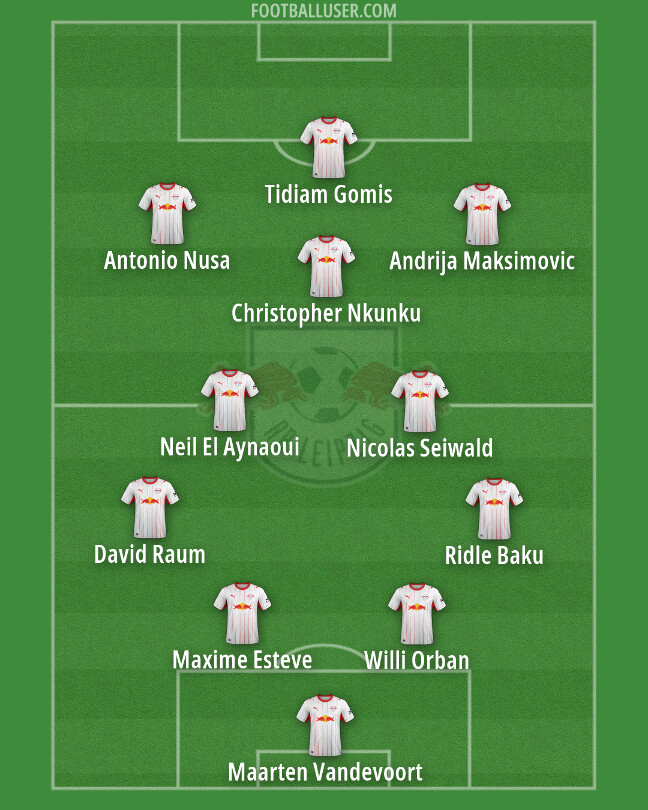
Our pre-season analysis concluded with Leipzig’s 6-0 Pokal win in Trier. Demichelis had finally settled on his 4-3-3. Nicolas Seiwald held the six. Banzuzi and Brajan Gruda advanced ahead of him. The fullbacks pushed. The eights attacked space. The counterpress tried to force the next attack before the opponent had finished processing the last one.
In other words, the laboratory work had ended. The Bundesliga would now tell us whether any of it actually worked. Demichelis changed only one relevant midfield piece for the league opener against Borussia Mönchengladbach. Reitz replaced Johan Bakayoko, with Gruda shifting from the eight role seen in Trier onto the right side of the attack.
After some time, the team delivered a performance worthy of the choreo.
Lineup—RB Leipzig (Match One)
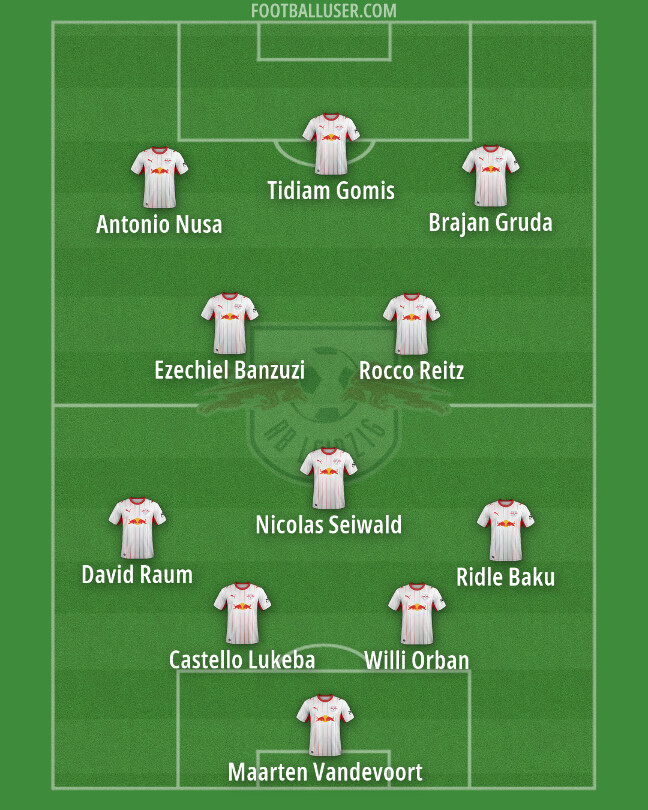
Gladbach were actually better for much of the opening 20 minutes. Eugen Polanski’s side played aggressively, moved the ball through Leipzig’s first pressure and struck the post through Hugo Bolin. RB did not register their first attempt until well into the opening half. Then Ridle Baku combined with Gomis for the opener in the 26th minute.
The match promptly became exactly the sort of game Leipzig wanted. Banzuzi began galloping into advanced central positions. Raum pushed up the left. Nusa received with room to accelerate. Gomis dropped, combined and released runners rather than remaining pinned between the centre-backs. RB began winning possession and attacking before Gladbach could reset.
Nusa made it 2-0 following a beautiful transition early in the second half. Moritz Nicolas then produced enough saves to prevent a considerably uglier scoreline before Reitz won the ball himself, continued forward and finished after Nkunku returned the pass. For reasons obvious enough, the third goal didn’t go over too well with the traveling BMG supporters. At least Reitz declined to celebrate.
Twenty-five shots. Nearly four expected goals. Only 47 percent possession. Demichelis probably would have taken that one home and framed it. The 3-0 victory illustrated precisely why the 4-3-3 had looked so promising during preparation. Leipzig’s advanced eights could attack the spaces around Gomis, the wide players could accelerate into open grass and the counterpress kept generating new attacks.
Then came Part I of the “famed football romanticism” in Bremen.
Injuries forced several personnel changes. Reitz and Gruda dropped out. Maxime Esteve replaced the unavailable Lukeba. Newly arrived Neil El Aynaoui entered midfield while Bakayoko returned on the right and Nkunku led the line.
The broad structure remained intact.
Lineup—RB Leipzig (Match Two)
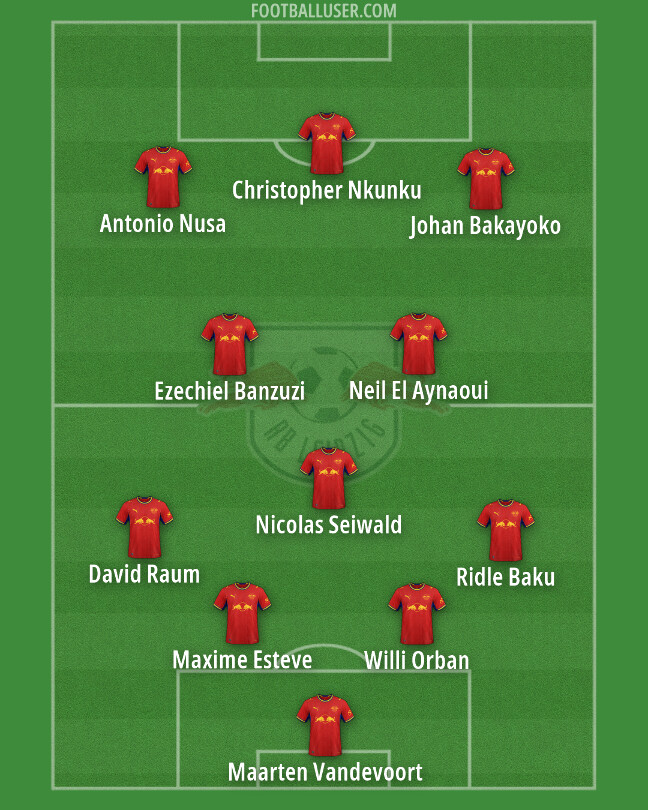
Werder promptly scored after a high regain in the fourth minute and spent much of the remaining afternoon defending deeply. Leipzig were invited to have the ball. They accepted the invitation with admirable politeness. Seventy-five percent possession after 17 minutes produced almost nothing beyond a rescinded penalty and one decent effort.
Bremen closed the centre, remained compact and waited for Leipzig to figure out another way through. RB struggled. The attacks increasingly worked toward the flanks, where Baku and Raum supplied crosses into an organised penalty area. Nkunku produced the only meaningful first-half chance after one such Baku delivery. Otherwise, there was plenty of possession and precious little penetration. A sentence no coach wishes to see written.
The pattern continued after the break. Bremen remained deep. Leipzig remained on the ball. Orban headed harmlessly from a set piece. Gomis came on for Bakayoko and immediately offered more central presence, but Werder doubled the lead when Niclas Füllkrug somehow found himself entirely unmarked off a 68th-minute corner.
Nusa struck the bar during Leipzig’s best spell. Marco Grüll then made it 3-0. Baku’s stoppage-time header changed very little. The final statistics—71 percent possession, 19 shots and roughly 1.5 xG—make the attacking performance look somewhat healthier than it actually felt. Much of Leipzig’s better chance creation arrived only after Bremen had established a comfortable lead.
The larger problem was obvious enough. Gladbach gave Leipzig disorder. Bremen gave them organization. RB knew what to do with the former while utterly failing to cope with the latter. Demichelis tried something different five days later in Como, in the process driving his team into what the German press deemed a “mini-crisis”.
For his first Champions League fixture as Leipzig trainer, the Argentine abandoned the familiar midfield triangle and installed an offensive 4-2-3-1. El Aynaoui joined Seiwald in the double six. Nkunku moved onto the ten. Andrija Maksimovic made his first start on the right. Marc Guiu led the line.
Lineup—RB Leipzig (UCL)
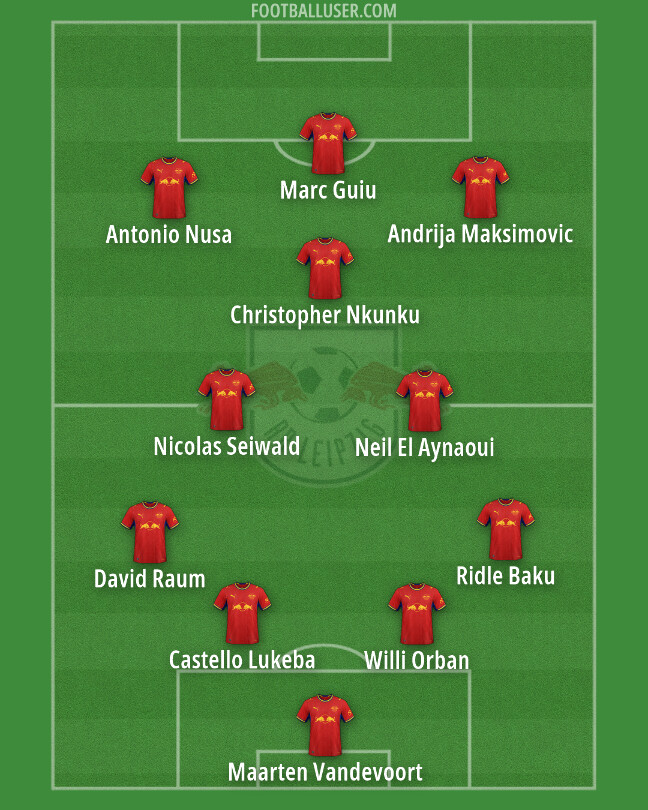
That was the shape with the ball.
Without it, Nkunku moved forward alongside Guiu as Leipzig pressed high in a 4-4-2.
Lineup—RB Leipzig (UCL)
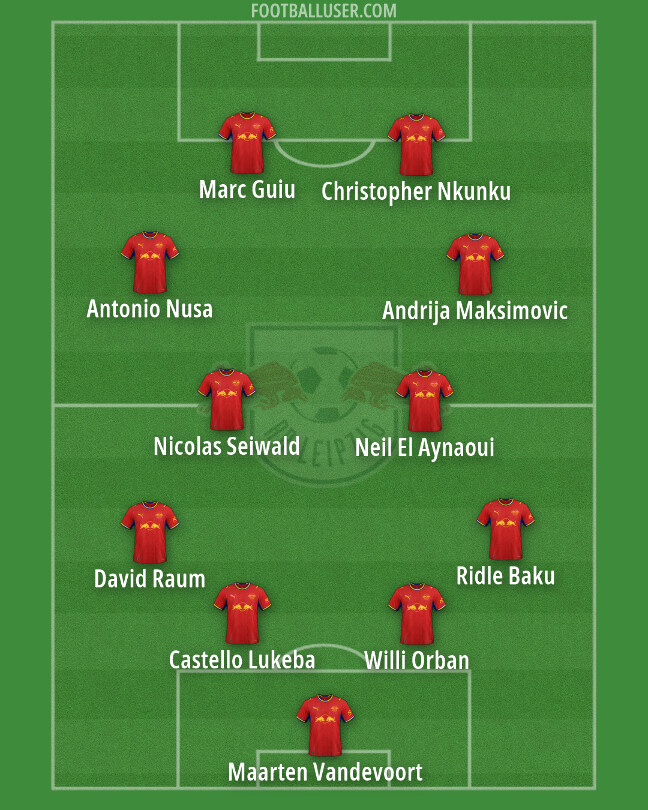
A perfectly sensible idea. There was just one small problem in that Como were rather good. Cesc Fàbregas’ team repeatedly escaped the high pressure with clean combinations and immediately attacked the spaces behind Leipzig’s advanced shape. Baku was caught away from his position during one early sequence. Assane Diao repeatedly attacked Raum on the opposite side.
Martin Baturina eventually scored after Baku failed to clear properly. Nusa nearly equalised immediately and Leipzig later produced two excellent chances through Maksimovic and Guiu. The latter headed wide from close range. Como scored again one minute later. That sort of thing tends to dampen morale.
Leipzig emerged from the break and seized territorial control. Nkunku became more involved. Nusa began attacking defenders. Como gradually retreated. RB still didn’t create very much. Como then demonstrated the rather important distinction between territorial dominance and actual control by countering through Leipzig for the 3-0.
Maksimovic pulled one back almost immediately after a Nico Paz error in build-up. Note the source of the goal. A mistake. Demichelis had seen enough and threw three new attackers on. Nkunku, Guiu and Seiwald departed. Banzuzi, Ouédraogo and Gomis entered. The resulting shape resembled an extremely aggressive 4-1-4-1, with El Aynaoui suddenly responsible for quite a lot of midfield.
Lineup—RB Leipzig (60th minute)
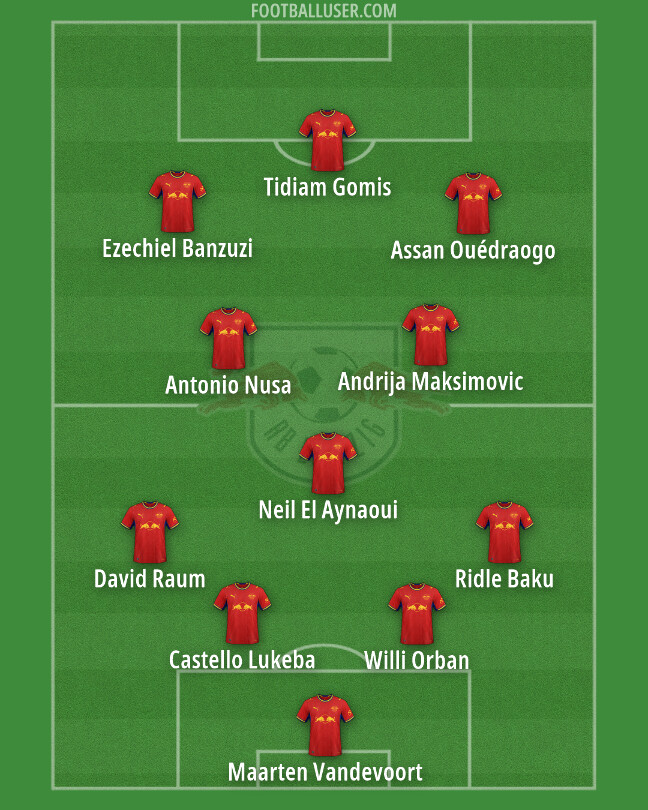
Gruda later replaced Maksimovic without fundamentally changing the attacking occupation. Nusa became the primary route toward goal, taking on multiple defenders and twice teeing up Ouédraogo. Banzuzi threatened from a corner. Gomis and Gruda combined on the right. Como simply defended. Leipzig ran. Como defended some more. Leipzig ran some more. Yawn.
Maximo Perrone eventually scored a fourth in the 90th minute.
We shall move on.
The schedule fortunately offered Leipzig a home fixture against a Hamburger SV side fresh off a 0-5 defeat against Mainz and forced into an uncomfortable defensive reshuffle. That constituted exactly the sort of gentle palate cleanser every team deserves after losing 1-4 in the Champions League.
Demichelis returned to the 4-3-3. Henrichs replaced Baku. Ouédraogo received his first Bundesliga start. Banzuzi stayed in the advanced midfield line and Gomis returned to the centre-forward position.
Lineup—RB Leipzig (Match Three)
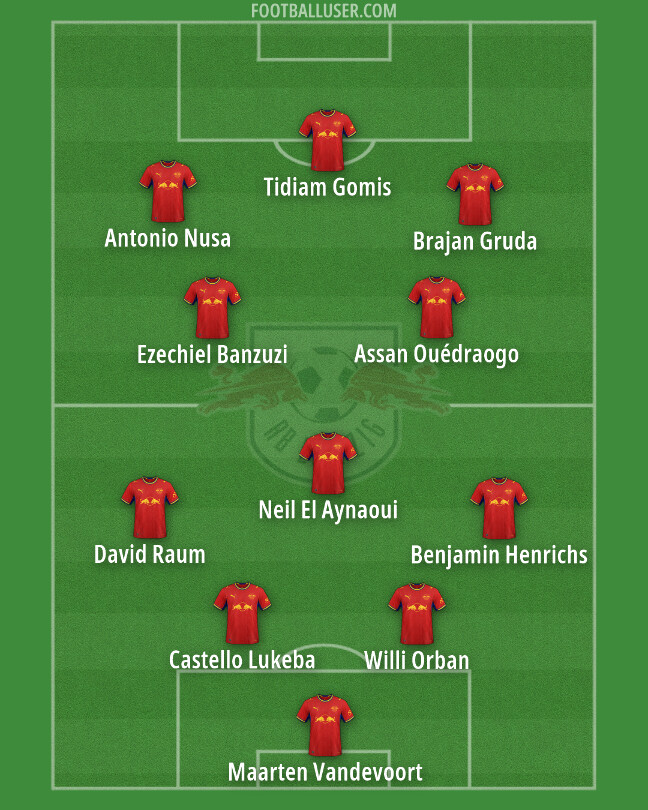
HSV actually began rather well. The Hanseaten pressed high and made Leipzig’s build-up uncomfortable during the opening ten minutes. Then Henrichs fired off a deflected long-range effort and RB gradually took over.
The opening goal was among the cleanest demonstrations of Demichelis’ intended football thus far. Gruda played vertically into Banzuzi’s run down the right. Banzuzi accelerated beyond the midfield line and squared. Gomis occupied the middle.
Tor!
Keep that one for the instructional video.
The second goal came via an entirely different mechanism. Nusa pressed the overwhelmed Nandja near the HSV penalty area, won possession and drove toward goal. Nandja’s desperate recovery challenge merely ricocheted the ball off Nusa and into the net.
Ouédraogo (the author writes with a tear in his eye) unfortunately lasted only 35 minutes before leaving with a shoulder problem. Nkunku replaced him in the advanced midfield role without forcing a fundamental structural change.
The second half then provided us with another reminder not to become too excited by scorelines. Hamburg created chances. David Møller Wolfe tested Vandevoordt. El Ouahdi found space repeatedly down the right. Patson Daka should have scored. At 2-0, this thing remained more alive than the final score now suggests.
Three goals in the span of six minutes didn’t help. Orban scored from a Nusa set piece in the 72nd. Nusa broke down the left and supplied Nkunku in the 74th. Romulo robbed Warmed Omari and ran through alone in the 77th. 5-0. Hamburg had officially fallen apart. Leipzig had played well, of course. The nature of the goals nevertheless remains worth noting.
Demichelis’ team had not suddenly become masters of dismantling a low block. They had become masters of making an already rather unhappy HSV afternoon substantially worse. The real test arrived in Leverkusen. Ouédraogo required shoulder surgery following his brief return. Lukeba missed out with minor groin problems. Gomis and Henrichs returned to the bench. Baku, Esteve, Nkunku and Romulo entered the XI.
Demichelis returned to the 4-2-3-1 seen in Como, this time pairing Banzuzi with El Aynaoui behind a Gruda–Nkunku–Nusa attacking line.
Lineup—RB Leipzig (Match Four)
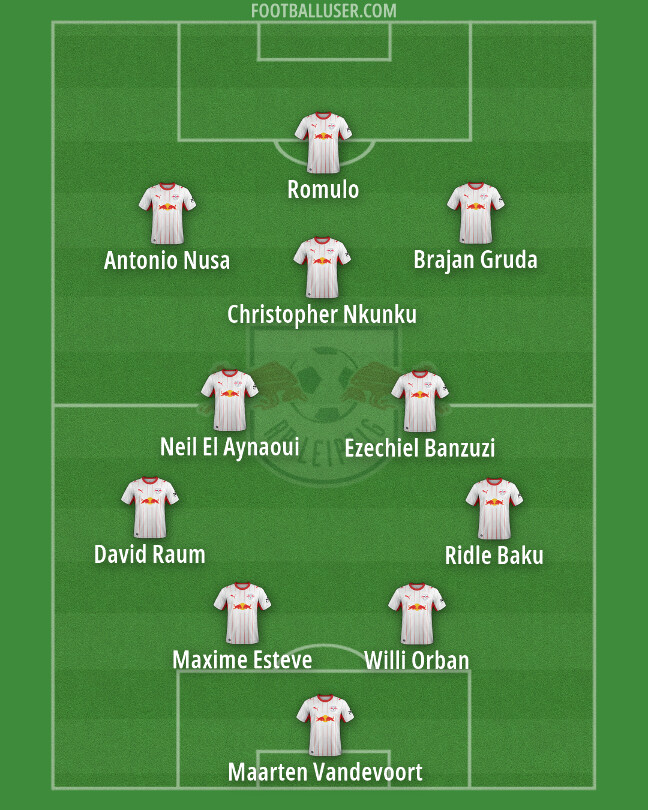
This one started well enough. Quite well, actually. Leipzig remained compact against the ball and largely denied Bayer meaningful access through the centre. Leverkusen held slightly more possession without creating much. RB won approximately 70 percent of the first-half duels.
Gruda’s latest injury setback forced Gomis on after 26 minutes, but Leipzig continued to look the slightly more dangerous side. They even scored. Orban switched play right. Nusa found Romulo vertically. Romulo attacked the area and squared. Nkunku finished. Lovely stuff.
Romulo was offside.
Never mind.
Leipzig’s performance remained stable until the defenders decided to add some plot. Orban carelessly lost possession near his own box in the 41st minute and escaped punishment when Vandevoordt stopped Schick. Three minutes later, Esteve sailed beneath Miguel Gutiérrez’s cross. Schick did not.
1-0.
Leipzig never truly recovered. After the restart, Maza escaped Raum and drove a low ball across goal. Orban let it run. Baku, seemingly unprepared for this particular development, cleared directly toward Miguel.
2-0.
Demichelis attempted to restore more conventional control after the hour. Seiwald replaced Banzuzi while Maksimovic came on for Romulo. Gomis moved into the center-forward role.
Lineup—RB Leipzig (67th minute)
This produced almost nothing. Leverkusen dropped into a compact block and Leipzig once again struggled to generate anything against it. More worrying was what happened defensively. Maza began carrying the ball through midfield with almost no resistance. Bayer found increasingly clean counterattacking opportunities. Leipzig’s line had disappeared along with the confidence.
Demichelis himself assumed full responsibility afterwards and spoke of his team having “two faces”. The “home face” has been direct, aggressive and efficient. The travelling version has thus far offered far too little of the intense high-pressing football the new trainer is supposed to be installing.
David Raum went one step further after Leverkusen.
When everything works and Leipzig score first, he noted, everyone is happy. The challenge comes when things begin moving in the opposite direction. Then somebody has to show character and take responsibility.
Fair enough.
Upcoming fixtures and assessment, RB Leipzig
Saturday, October 10th
Eintracht Frankfurt (H) 18:30
Tuesday, October 13th
PSV Eindhoven (H) 21:00
Saturday, October 17th
Bayern München (A) 18:30
The extended international break comes at a rather useful time. Ouédraogo must recover from shoulder surgery. Gruda was forced to withdraw from Jürgen Klopp’s XXL roster with an abdominal injury. Baumgartner should continue progressing toward full fitness. Nkunku and Romulo could both use more training time.
Demichelis needs some too. Nothing we’ve seen thus far suggests that his fundamental idea is flawed. Quite the opposite. Leipzig’s 4-3-3 works very well when the press creates turnovers, the eights attack forward and Nusa or Gruda receive opportunities to accelerate before the opposition defence can settle.
The problems concern what happens when those conditions disappear. Deep blocks have frustrated Leipzig. Technically secure opponents have played through the high press. Individual defensive mistakes have turned manageable situations into goals.
Most concerning of all, going behind has tended to change the personality of the entire team.
The upcoming sequence should tell us plenty. Frankfurt ought to provide a strong home test. PSV will challenge Leipzig’s pressure resistance. Then comes Bayern away. An away fixture.
Oh dear.
Demichelis at least has some time to figure out how to pack the “good face” against the club he represented for so long and that actually launched his coaching career. Three losses might quickly increase pressure on the Bundesliga’s first Argentine trainer. Without Klopp in the RB Cosmos, Demichelis has one ally less.