

From Germany to Italy, from Belgium to Türkiye, from France to Greece, Ricardo Faty’s professional football journey has taken quite a few twists and turns, but now, he’s back to where it all started: INF Clairefontaine.
Born in Villeneuve-Saint-Georges on August 4, 1986, Faty got his first big break after being accepted into France’s preeminent academy (Institut national du football de Clairefontaine) and plying his trade there from 1999 to 2002 before eventually leaving the Parisian suburbs and making the move to Strasbourg. He broke into the first team during the 2005/06 season, making 15 appearances – one coming vs. Roma in the UEFA Cup – before attracting the interest of Roma.
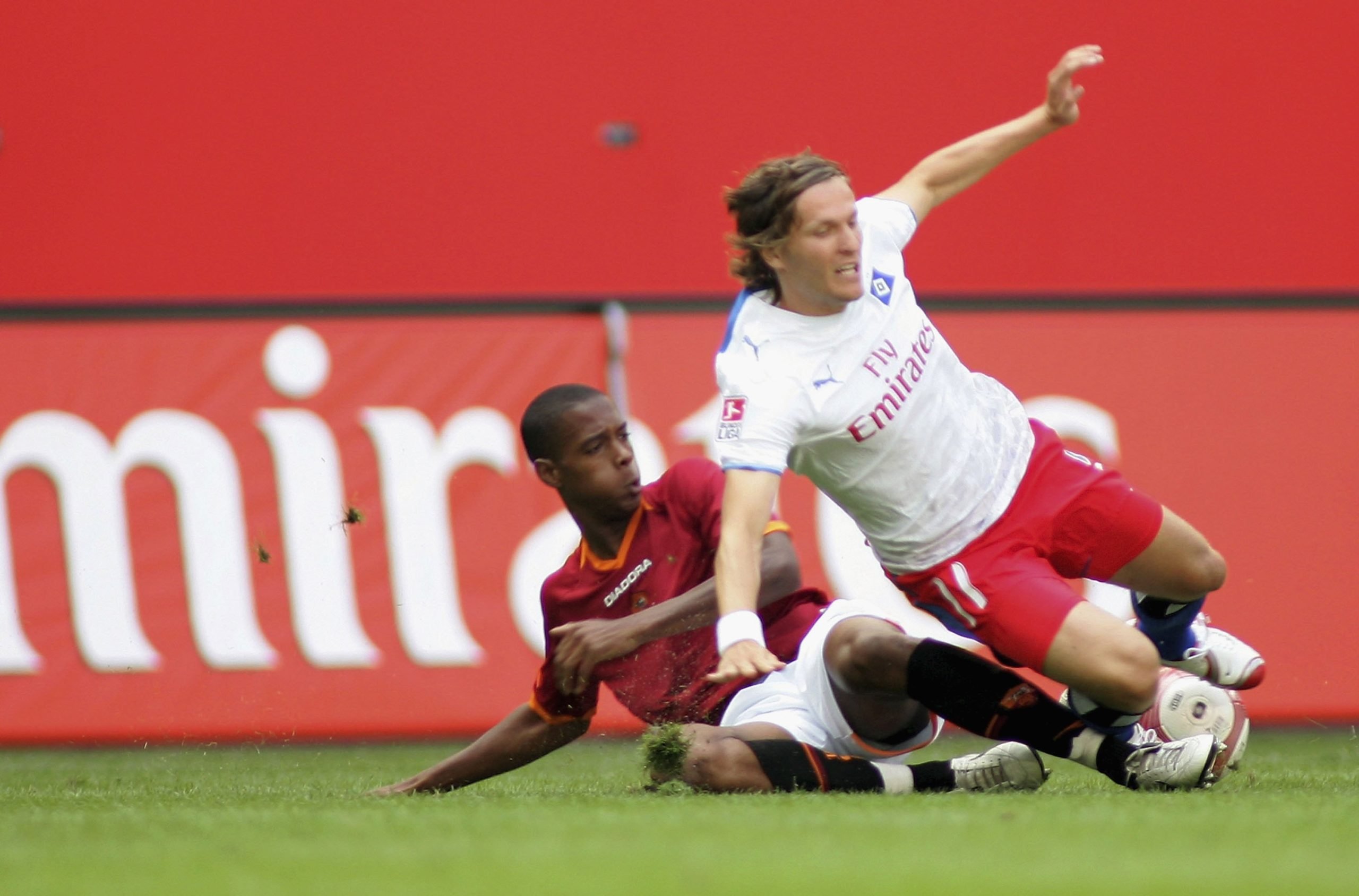
Taking advantage of Strasbourg’s relegation and his lack of a professional contract, Roma signed him for €350,000, with Faty making 15 appearances and helping Roma win their first trophy in six years with the 2006/07 Coppa Italia title. He was able to make his mark against a number of elite sides like Lyon, Manchester United, and Milan, excelling against 1999 Ballon d’Or winner Rivaldo in a 1-0 victory at Olympiacos on his UEFA Champions League. However, he failed to oust the likes of Daniele De Rossi, Simone Perotta, and David Pizarro from the starting line-up, prompting him to depart Italy and start a new chapter in Germany with Bayer Leverkusen. But whilst he initially signed a two-year loan, Faty opted to cut his time short in the Bundesliga after just half a season. In his place, the likes of Toni Kroos and Arturo Vidal would take root in Die Werkself’s midfield and sow the seeds for world-class careers.
“At that time, I considered Leverkusen a good choice, because they did everything to bring me there. The Sporting Director Rudi Völler did everything to bring me there, and even the project was nice, it was actually a good team. Maybe I wasn’t ready for this type of situation because I went to a new team, a new country, a new culture, and I was discovering a new way of playing,” stated Faty in an exclusive Get German Football News interview. “Maybe it was not the right step for me: maybe I should have stayed in Italy or have gone back to France to be in a more specific environment. But it wasn’t good for me, and I wasn’t ready for that. I have to be honest: the coach may not have been passionate about me, he didn’t see me at all, so that’s why I remain bitter about this period in Leverkusen, because I think that I could have had a chance there, but I’ve learned a lot about this situation. Maybe I could have stayed for the entirety of my two-year loan, but instead, I decided to leave after six months. Maybe I could’ve stayed a bit more to show them and also to prove to myself that I could make it, but I was too impatient at that time. I left after six months, I went back to France, but honestly, it was still a good experience: I learned a lot during this experience there.”
After playing just three times for Leverkusen, Faty returned to France and guided Nantes to promotion, before suffering relegation the following season. He then returned to Roma, making 11 appearances across the 2009/10 season, before starting a new journey with Greek outfit Aris Salonica. Faty made 56 appearances across his time in Thessaloniki, but he was forced to call it quits after going unpaid during his second season on account of the Greek financial crisis. It’s why he decided to return to Ligue 1 and make the move to AC Ajaccio in 2012 – the same year that he switched over from France to Senegal and made five appearances for the Lions of Teranga. But just when it looked like Faty was on track to establish himself as one of the best midfielders in France, he tore his Achilles.
“Everyone experiences their prime at a different age, some peak at 23, some at 23…I was doing well at Ajaccio and could have hit my peak at 27, but once I got injured, it all fell apart. But when I recovered, it took me one year to be 100% again, 100%, and at 29, I was good. Maybe it’s a mix between experience and the body being a bit stronger, maybe less pressure and more knowledge of the game made me feel that I got my peak at that age. But maybe if I hadn’t gotten injured in 2013, I could have hit my peak at 26/27 years old. I felt stronger than ever at 29/30, maybe I had a late maturation, I don’t know.”
Having made 50 appearances for Ajaccio, Faty left Corsica following the club’s relegation and made the move to Belgian side Standard Liège, where he spent a lone season before making the move to Türkiye. He established himself as one of the top defensive midfielders in the Süper Lig with Bursaspor and MKE Ankaragücü, before heading back to Italy and playing for Serie B side Reggina. And after a swan song with C’Chartres Football in the French fourth tier, he hung up his boots in 2023 and has since spent his time raising his three daughters in Paris (his son is playing basketball in Providence, Rhode Island), working as a pundit for major French television outlets, and coaching the top boys and girls of the Île-de-France region region in INF Clairefontaine.
“I have three daughters and one son, so I need to organize everything. I’m very busy in my new life, which is very good and nice. My son is going to high school in Rhode Island, where I have family. I’m coaching at Clairefontaine now, so my average day is: I wake up in the morning, I bring my daughters to school, then I come back home, watch some games and highlights until 10:30 a.m., when I go to the Clairefontaine academy and start the briefing of the training and everything with the other guys there. We prepare the sessions, then we have lunch at noon, then players come at 1:30, and then we start training with the boys at 2.30, and then I’ll train with the girls from 4:35 to 6 or 7 p.m. I’ll then leave, debrief everything, and I’m at home 7/7.30…that’s my average day.”