

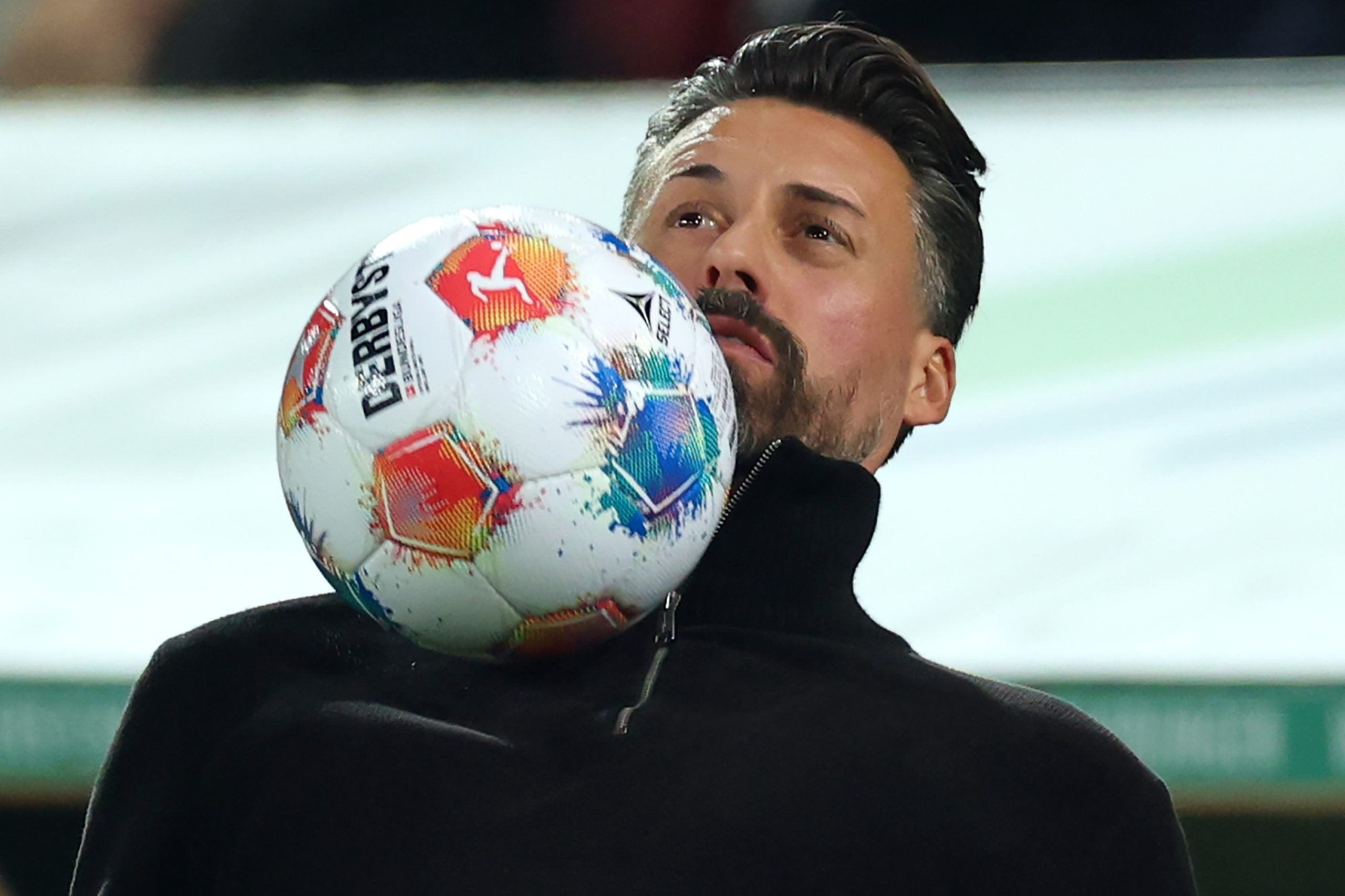
On the occasion of FC Augsburg’s sacking of head coach Sandro Wagner, Get German Football News is pleased to supply a retrospective of one of the most turbulent and tumultuous head coaching tenures in recent Bundesliga history. Wagner counted as one of the more popular and interesting choices to train a top flight club. In the end, however, the former DFB assistant simply proved – from the beginning – that he wasn’t cut out to handle a team at this level.
Nearly one week since Wagner’s dismissal, German the footballing editorial pages of the Bundesrepublik are still buzzing. Questions abound. How could with such footballing expertise and such a magnetic personality have failed so quickly and so thoroughly? Will the figure many Germans thought could lead the national team someday even get another coaching appointment? How could so many German footballing diehards have been so wrong about Wagner.
In order to answer such questions, we must probe the short coaching regime of Wagner in depth. Unfortunately for the 38-year-old, he found himself stuck in the middle of a club re-brand that never quite jived with the fans. Additionally, there was plenty of naiveté from Wagner in the way he handled both the team and the press in his first Bundesliga appointment. Fortunately, there’s cause for hope that someone as intelligent as Wagner can do much better next time.
Augsburg’s Massive Summer Overhaul
Under previous trainer Jess Thorup, FC Augsburg were able to clinch Bundesliga safety relatively early (matchday 29) last season. A full decade had passed since the European days during former trainer Markus Weinzierl’s first stint coaching the club. After Weinzierl led Augsburg to Europe at the end of the 2014/15 campaign, Augsburg battled relegation in every season since. Oftentimes, safety was only confirmed on the final day of the season.
The club nevertheless tired of the constant battle against the drop. At the time Thorup’s crew clinched safety, Augsburg remained in the hunt for Europe. Unfortunately, they were only able to gain one more point from their final five league fixtures. After drawing Eintracht Frankfurt on matchday 30, Thorup’s team went on to lose their final four games against Bayer Leverkusen, Holstein Kiel, Stuttgart, and Union Berlin.
Both Thorup and sporting director Marinko Jurendic were sacked after the season. Wagner – whom many had considered ready for a top flight coaching appointment following his stints with SpVgg Unterhaching and the German national team – was brought in first. The front office was then totally restaffed.
Former Paderborn managing director Benjamin Weber (sporting director), former Bochum sporting director Marc Lettau (squad planner), former FCA head coach Manuel Baum (academy director) and former Augsburg player Julian Baumgartlinger (player licensing coordinator) all took up their posts in July.
We then have to talk about this club’s “Roman Re-branding”. Ugh. Augsburg were always known as the “Fuggerstädter” based on the city’s association with the Fugger banking family. The city is also famous for its book fair and puppeteering tradition. Banking? Books? Puppets? The club decided this was too boring.
Enter the attempts to re-define Augsburg based on its initial Roman roots. Rome’s first official emperor Caesar Augustus initially founded the encampment known as “Augustus Vindelicum”. The fierceness of the most brutally effective army to ever march on the earth certainly beats…banking…books…and puppets.
Ahead of the current season, the FCA unveiled a special “Roman tricot” and associated merchandise. The tunnel at the WWK-Arena was re-designed, Schalke-style with a Roman style wall and a gate at the end to make it appear as if – before entering the pitch – the players were preparing for gladiatorial combat.
And yes, as mentioned in a previous GGFN piece, Augsburg members (including this one) received oddly shaped stones in the post. This all proved a bit much. As the team’s performance degenerated, it turned out to be a total joke. Banking, books, and puppets beat…whatever the hell this was.
Summer Transfer Market and Training Camp
Club executive Michael Ströll served as the sporting director on an interim basis until the new administrative team moved in. Ströll remained proactive on the transfer market and it’s fair to say that Augsburg brought in one of their better transfer classes in recent memory. During the latter years of his tenure, current club advisor Stefan Reuter often threw money (graced him by U.S.-based investment firm) at random players without much thought to squad balance.
The roster put together this summer showed plenty of promise, but Wagner’s influence near the end of the transfer window raised plenty of questions. In particular, Wagner’s decision to ship Steve Mounie out on loan despite a promising training camp left one wondering just what sort of plan Wagner had in place. The FCA trainer justified his decision based on Mounie’s potential participation in the December/January AFCON, but the choice remained questionable.
Early signs of trouble
Augsburg’s surprise opening day upset over Freiburg left Wagner crediting predecessor Thorup for leaving him a “stable team”. All appeared to be well save for the fact that the 1-3 result came courtesy of three Augsburg goals scored in quick succession near the end of the first half. The Breisgauer hosts simply collapsed during a particular stretch and the win maintained a fluky feel about it.
One week later in away at Bayern, the team’s late attempts at a comeback was overshadowed by Wagner’s comments on a nasty aerial collision that landed Robin Fellhauer in the hospital. Wagner would later take heat for the manner in which he handled this situation in an editorial written for Kicker Magazine by legendary German football trainer Friedhelm Funkel.
A defeat against St. Pauli after the September international break did reveal that the team itself seemed confused about the type of football Wagner wanted them to play, but this particular GGFN author was still prepared to stick with his fellow German. Quite erroneously, it would turn out. Several disasters which Wagner simply couldn’t explain away followed.
The Mainz and Heidenheim losses
When Wagner’s crew found themselves picked apart at home by shorthanded Mainz, Wagner already struggled to pinpoint what was wrong. A medical emergency in Heidenheim the very next week spared Wagner’s blushes as the cancelled post-match press conference meant he was excused from offering up any further explanations.
Fortunately enough, a win against lowly Wolfsburg the very next week captivated the (biased) imagination of those of us Germans rooting for Wagner. We were more than pleased to declare the team back on the right track when it came to how the young trainer was handling his young talent. Wagner – thanks in part to his inherent charm – was once again given carte blanche.
An unavoidable losing streak
When Augsburg could only manage a draw against 1. FC Köln in the first match back from the October international break, matters quickly became worrisome again. The upcoming league fixture list of RB Leipzig, Borussia Dortmund, and VfB Stuttgart portended three straight losses. As soon as Leipzig destroyed Wagner’s crew 0-6 at home on matchday eight, one began to fear that the team wouldn’t be able to recover in time for their Pokal match against Bochum.
As feared, the team dropped both their home cup match and their next home league fixture. Three straight home losses in the span of only six days wasn’t something either the team or the fan-base could hope to recover from. A predictable loss against Stuttgart away on match-day ten sent Augsburg into the November international break on a four match losing run. During the Dortmund home loss, protests from the fans against the rebranding began.
The final days
There isn’t much to add to the tight home win against Hamburger SV and the humiliation against Hoffenheim that followed. One could immediately infer from Wagner’s post-match comments that he would be released as soon as the weekend was out. This whole re-branding in the interest of making Augsburg more “sexy” turned into a grotesque mess. The time to fall back on an old coach and get back to the boring nature of banking, books, and puppets had come.
What is the future of Augsburg?
Most all can surely agree that the roster – while it contains many young and exciting talents – isn’t nearly as strong as we initially thought it was. Unless a reliable striker is procured during the January transfer window, it will be difficult for the Fuggerstädter to pull away from the relegation pack. The defense – which many of us felt had been uncharacteristically leaky – has tightened up a bit, yet still conceded the second most goals in the league (27) behind Frankfurt.
Manuel Baum, whether he likes it or not, is probably the right man to restore some stability to this club. Baum himself is in desperate need of a redemption arc after his nightmare stint with Schalke and the fans seem to be happy to have someone from the “old guard” back. Just as Markus Weinzierl did during the final days of the 2020/21 campaign, it appears as if one of the old familiar faces is needed to help avoid relegation.
Baum’s task isn’t all that difficult. All he needs to do is sort out the defense and get the team back to being boring again. While there remains plenty of football left to be played, the team seems decent enough to hover above the relegation fray whilst other even wobblier teams struggle to make up ground. A 13-point-haul through 13 matchdays still keeps the club on course to come close the magic number of 35 by seasons’ end.
What is the future of Wagner?
There should be absolutely no doubt that the relatively young trainer will receive another Bundesliga offer before to long. That is, of course, he doesn’t return to Julian Nagelsmann over at the German national team. Club coaching remains a tough business and Wagner himself must decide whether or not he wishes to give it another go. No real opportunities fit him at this point. He can obviously take his time.
The national team constitutes a much safer haven with a significantly lighter workload. Though the pressure during the major tournaments remains immense, a national team trainer mostly does light scouting work for most of the year. One shouldn’t forget that Nagelsmann himself wasn’t an especially successful coach. He captured just one title in his stint with FC Bayern München.
Additionally, no German forgets the fact that Jogi Löw was a memorable failure as a club coach at multiple stations before his decision to work as Jürgen Klinsmann’s assistant left him in the right place at the right time after the 2006 World Cup. Hard as it may be to believe, Wagner may havre some valuable experience to bring back to the DFB after his five-month-long hiatus.
One thing the author must bring up in his conclusion is that it did appear as if Wagner cared for many of his specific players and that some of them were excited to play for him. As a player, Wagner traversed more than his fair share of adversity. Had there been less pressure and focus on him here, he might have gotten more time.
And yes, the Roman-rebranding is stupid.
Let it go.
Thumbs down!