

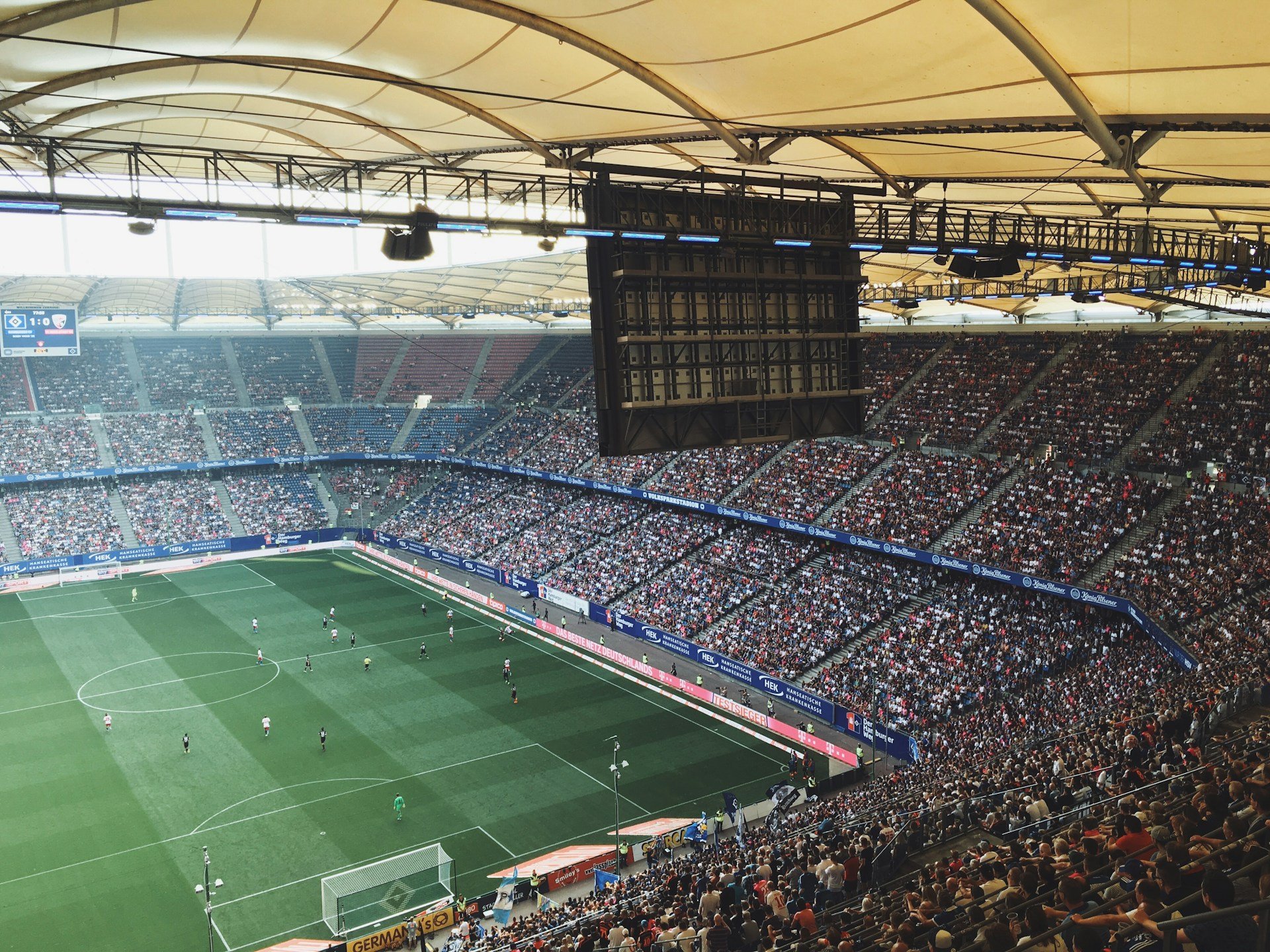
The roar of 80,000 fans in Dortmund’s “Yellow Wall.” The unified chant of “FC Bayern, Stern des Südens” echoing around the Allianz Arena. The German Bundesliga is an overwhelming sensory experience. For a football fan, it’s the pinnacle of passion. But for a language learner, it’s also a classroom operating at 120 decibels.
This guide is about harnessing that passion. Forget dry verb tables and abstract grammar drills. The most effective way to learn a language is through immersion, and there is no more immersive (or loud) environment than a German football stadium. While your university syllabus is full of complex assignments, which might tempt you to find a professional writing service and have writers write a paper for me just to cope, learning German doesn’t have to be a chore.
Why Football is Your Best Language Teacher
Learning a language in a classroom often feels sterile. You learn words, but you miss the emotion and the cultural context. Football provides what a textbook cannot: an immediate, passionate, and repetitive application of the language.
When a chant is repeated by 20,000 people, you learn the rhythm, the intonation, and the emotional weight of the words. You are learning the language as it is actually used by a community, which builds a far stronger neural connection than a flashcard.
The Matchday Starter Pack: Core Vocabulary
Before you can understand the chants, you need to know the key terms you’ll hear every few seconds from the commentator and the crowd. This is your essential vocabulary list.
Key Nouns (The Players & Places):
- Das Tor (The Goal): You’ll hear this shouted with immense joy (or despair). Also means “the gate.”
- Der Schiedsrichter (or Schiri) (The Referee): The person everyone loves to hate.
- Abseits (Offside): A crucial and often controversial call.
- Ecke / Eckball (Corner / Corner Kick): A common set piece.
- Stürmer (Striker): The player responsible for scoring goals.
- Verteidiger (Defender): The player trying to stop the goals.
- Wechsel (Substitution): When a player is swapped out.
Key Verbs (The Action):
- schießen (to shoot)
- laufen (to run)
- passen (to pass)
- halten (to save, as in a goalie)
- gewinnen (to win)
- verlieren (to lose)
Key Phrases (The Situation):
- “Gute Besserung!” (Get well soon! – often yelled sarcastically when a player dives.)
- “Das gibt’s doch nicht!” (That can’t be happening! / Unbelievable!)
- “Hand!” (Handball!)
The Sound of the Stadium: Classic Chants (and the Grammar They Teach)
This is the core of your new curriculum. Chants are simple, repetitive, and packed with useful grammar. Let’s break down a few classics you’ll hear at almost any match.
- The Command: “Auf geht’s!”
- The Chant: “Auf geht’s [Teamname], schieß ein Tor!” (Let’s go [Team Name], score a goal!)
- The Linguistic Lesson: This chant is your perfect introduction to the imperative (command) form. “Schieß!” (from the verb schießen) is the command “Shoot!” You are telling the player what to do. “Auf geht’s!” is a classic German phrase for “Let’s go!” or “Come on!”
- The Conditional: “Steht auf…”
- The Chant: “Steht auf, wenn ihr [Teamname-Fans] seid!” (Stand up, if you are [Team Name] fans!)
- The Linguistic Lesson: This chant is a fantastic, real-world example of a conditional “wenn… dann” (if… then) clause. You are setting a condition (“if you are fans”) for an action (“stand up”). It also drills the verb sein (to be) in its plural form: ihr seid (you are).
- The Advanced Subjunctive: “Ohne…”
- The Chant: “Ohne [Rival Team], wär’n wir gar nicht hier!” (Without [Rival Team], we wouldn’t even be here!)
- The Linguistic Lesson: This chant, often sung ironically about a rival, is a goldmine for advanced learners. It teaches the subjunctive mood, which is used for hypothetical situations. “Wär’n wir” is a contraction of wären wir, meaning “we would be.” It’s a complex piece of grammar you’ll remember instantly because it’s tied to the passion of a derby.
Beyond the Terrace: Phrases for the Pub
(https://unsplash.com/photos/close-up-of-a-white-line-on-green-grass-in-a-soccer-field-HgwY_YQ1m0w)
After the match, the discussion continues at the local Kneipe (pub). Knowing a few key phrases will help you join the conversation, celebrate a win, or (more likely) complain about the referee.
- “Was für ein Tor!” (What a goal!)
- “Das war niemals Abseits!” (That was never offside!)
- “Der Schiri ist blind!” (The referee is blind!)
- “Eine klare Fehlentscheidung.” (A clear bad call.)
- “Prost!” (Cheers!)
The Deeper Connection
Learning a language through its culture is more than just a “life hack.” It’s a way to connect with the mindset of the people. As Phil Collins, an MBA professor who also contributes to the essay writing service EssayService, often advises students, “Immersion is the fastest path to fluency, but cultural immersion is the only path to genuine understanding.”
Mr. Collins notes that academic pressure is immense, but writing services like EssayService can handle complex assignments, freeing up a student’s mental energy to engage with their new environment. Whether it’s in a museum or a football stadium, that cultural engagement is where real learning happens.
Conclusion
The Bundesliga offers a language-learning experience that is loud, passionate, repetitive, and deeply effective. It transforms the abstract rules of German grammar into the shared, emotional language of 50,000 people.
So, next time you tune in to a match, listen a little closer. You’re not just watching a game; you’re sitting in one of the most effective language classrooms in the world.